

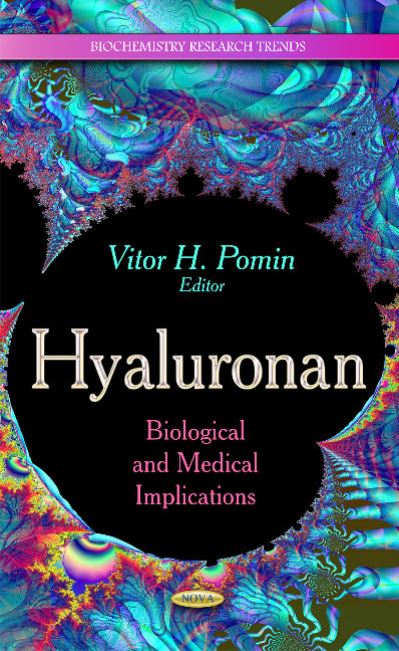
Hyaluronan or hyaluronic acid (HA), the only non-sulfated glycosaminoglycan (GAG) of the body, is structurally composed of disaccharide repeating units of alternating 3-linked N-acetyl ?-D-glucosamine and 4-linked ?-D-glucuronic acid. Despite the lack of sulfation and the lowest structural heterogeneity among all GAGs, HA still retains efficient capability in interacting with many molecules, especially functional proteins like growth factors, cytokines, and adhesive proteins involved in angiogenesis, tumour proliferation, migration and invasion.
However, the main biological role of HA is to assemble the extracellular matrices of certain soft tissues, such as vitreous humour, synovial fluid, umbilical cord and the intercellular space of the epidermis. HA is the major structure-forming component in the globe of the eye and cornea. For this reason, this GAG can be used to compose ophthalmic solutions.
The most famous physicochemical property of HA is its capacity to make gels in solution. This property can be pharmaceutically and industrially useful as either a vehicle to make specific media or biologically active sera. This book, heavily based on recent scientific results from research groups of several countries, will cover many of these aspects of HA, the related enzymes and metabolism in health and disease.
The seven chapters are basically centred in:
| ISBN: | 9781631178085 |
| Publication date: | 1st June 2014 |
| Author: | Vitor H Pomin |
| Publisher: | Nova Science Publishers an imprint of Nova Science Publishers, Inc |
| Format: | Hardback |
| Pagination: | 123 pages |
| Series: | Biochemistry Research Trends |
| Genres: |
Biochemistry |
Hyaluronan or hyaluronic acid (HA), the only non-sulfated glycosaminoglycan (GAG) of the body, is structurally composed of disaccharide repeating units of alternating 3-linked N-acetyl ?-D-glucosamine and 4-linked ?-D-glucuronic acid. Despite the lack of sulfation and the lowest structural heterogeneity among all GAGs, HA still retains efficient capability in interacting with many molecules, especially functional proteins like growth factors, cytokines, and adhesive proteins involved in angiogenesis, tumour proliferation, migration and invasion.
Hyaluronan features in the following genres: Biochemistry
Hardback. Not Available.
Hyaluronan was written by Vitor H Pomin and published by Nova Science Publishers an imprint of Nova Science Publishers, Inc
Hyaluronan has 123 pages
Yes it is part of Biochemistry Research Trends series