

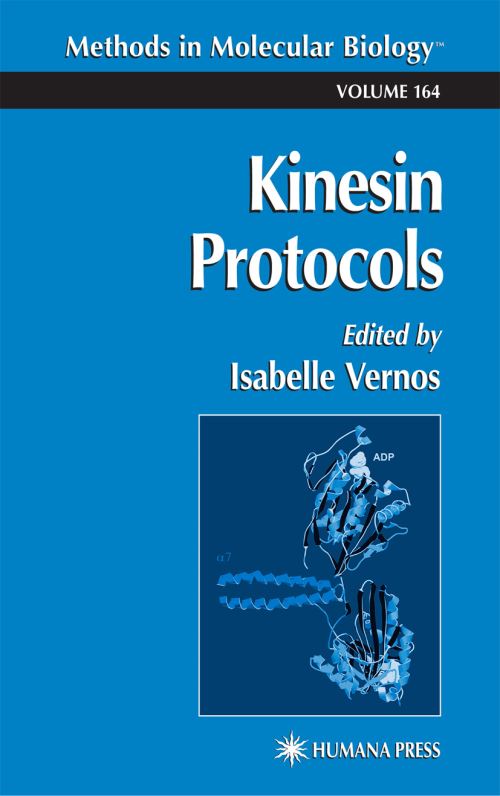
By the end of the 1980s only two microtubule-dependent motors, the plus end-directed kinesin and the minus end-directed cytoplasmic dynein, had been identified. At the time, these two motors seemed almost sufficient to explain directional motility events on polar microtubule tracks in the cell. No- theless, shortly after, the tip of the iceberg began to emerge with the identi- cation of proteins containing in their sequences a domain found in kinesin.
This domain, called the "motor domain," conferred on these proteins the essential property of moving on microtubules, using the energy derived from ATP hydro- sis. Since then, the identification of new proteins belonging to the kinesin superfamily of microtubule-dependent motors has gone at such a pace that nowadays more than 200 entries with motor domain sequences are deposited in the database. Kinesin family members are found in all eukaryotic org- isms tested.
They present a wide range of domain organizations with a motor domain located at different positions in the molecule. Their motility prop- ties are also variable in directionality, velocity, and such other characteristics as bundling activity and processivity. Finally, and most important, they p- ticipate in a multitude of cellular functions.
Our understanding of many cel- lar events, such as mitotic spindle assembly and neuronal transport, to cite only two, has progressed substantially in the last few years thanks to the id- tification of these motors.
| ISBN: | 9781617371783 |
| Publication date: | 10th November 2010 |
| Author: | Isabelle Vernos |
| Publisher: | Humana Press |
| Format: | Paperback |
| Pagination: | 258 pages |
| Series: | Methods in Molecular Biology |
| Genres: |
Cellular biology (cytology) |
By the end of the 1980s only two microtubule-dependent motors, the plus end-directed kinesin and the minus end-directed cytoplasmic dynein, had been identified. At the time, these two motors seemed almost sufficient to explain directional motility events on polar microtubule tracks in the cell.
Kinesin Protocols features in the following genres: Cellular biology (cytology)
Paperback, Hardback. Not Available.
Kinesin Protocols was written by Isabelle Vernos and published by Humana Press
Kinesin Protocols has 258 pages
Yes it is part of Methods in Molecular Biology series