

The martial enthusiasm that engulfed the North when the American Civil War commenced in April 1861 vanished by the following summer. Repeated military defeats, economic worries, and staggering casualties prompted many civilians to question the war's viability. Frustration exploded into anger when Republican president Abraham Lincoln issued his preliminary Emancipation Proclamation in September.
The disgruntled voices grew louder. These anti-Lincoln Democrats, nicknamed "Copperheads," viewed blacks with disdain and considered many of Lincoln's legal decisions to be unconstitutional. Civilian disenchantment led to significant Republican defeats in the November Congressional elections. As 1862 ended, Northern morale was at rock bottom.
Across the North, ardent pro-Lincoln men realized their country needed a patriotic stimulus, as well as an organized means of countering what they viewed as theirCopperhead adversaries' treasonous pronouncements and subversion. These men formed what became known as Union Leagues: semisecretive societies whose members had to possess unconditional loyalty to the Lincoln administration and unwavering support for all of its efforts to suppress the rebellion. Their mysterious member initiation rites were likened to a solemn religious ceremony.
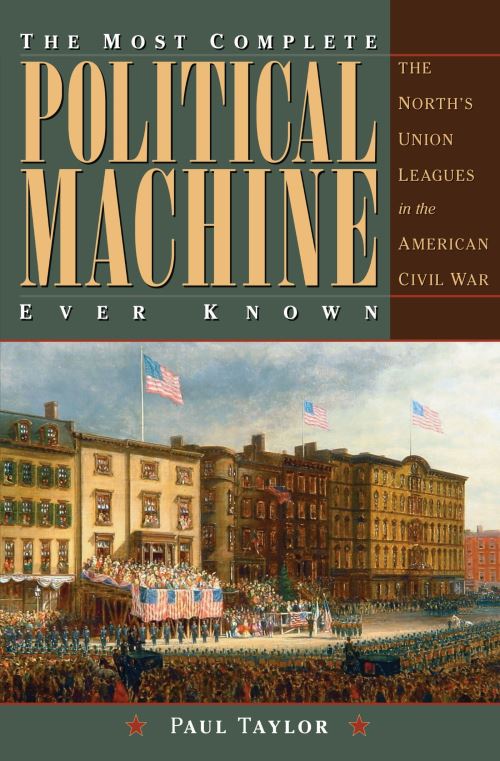
In The Most Complete Political Machine Ever Known, Paul Taylor examines the Union League movement. Oftenportrayed as a mere footnote to the Civil War, the Union League's influence on the Northern home front was far more important and consequential than previously considered. The Union League and its various offshoots spread rapidly across the North, and in this first comprehensive examination of the leagues, Taylor discusses what made them so effective, including their recruitment strategies, their use of ostracism as a way of stifling dissent, and their distribution of political propaganda in quantities unlike anything previously imagined.
By the end of 1863, readers learn, it seemed as if every hamlet from Maine to California had formed its own league chapter, collectively overwhelming their Democratic foe in the 1864 presidential election.
| ISBN: | 9781606353530 |
| Publication date: | 8th May 2018 |
| Author: | Paul Taylor |
| Publisher: | Kent State University Press an imprint of The Kent State University Press |
| Format: | Hardback |
| Pagination: | 328 pages |
| Series: | Civil War in the North |
| Genres: |
Civil wars Early modern warfare (including gunpowder warfare) Diaries, letters and journals History of the Americas |
The martial enthusiasm that engulfed the North when the American Civil War commenced in April 1861 vanished by the following summer. Repeated military defeats, economic worries, and staggering casualties prompted many civilians to question the war's viability.
"The Most Complete Political Machine Ever Known" features in the following genres: Civil wars, Early modern warfare (including gunpowder warfare), Diaries, letters and journals, History of the Americas
Hardback. £32.40, down from the £36.00 cover price. Not Available.
"The Most Complete Political Machine Ever Known" was written by Paul Taylor and published by Kent State University Press an imprint of The Kent State University Press
"The Most Complete Political Machine Ever Known" has 328 pages
Yes it is part of Civil War in the North series
£32.40, reduced from £36.00. Not Available.