

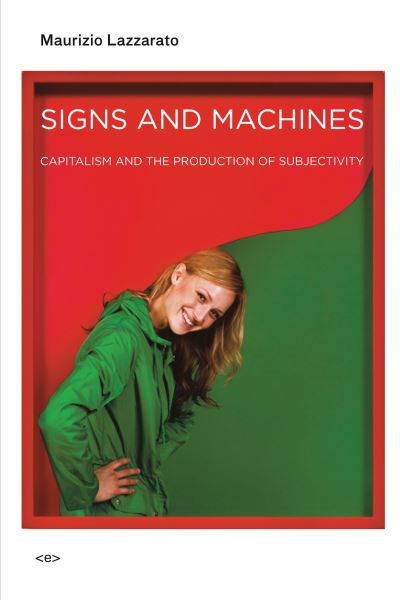
An analysis of how capitalism today produces subjectivity like any other "good," and what would allow us to escape its hold.
"Capital is a semiotic operator": this assertion by Félix Guattari is at the heart of Maurizio Lazzarato's Signs and Machines, which asks us to leave behind the logocentrism that still informs so many critical theories. Lazzarato calls instead for a new theory capable of explaining how signs function in the economy, in power apparatuses, and in the production of subjectivity.
Moving beyond the dualism of signifier and signified, Signs and Machines shows how signs act as "sign-operators" that enter directly into material flows and into the functioning of machines. Money, the stock market, price differentials, algorithms, and scientific equations and formulas constitute semiotic "motors" that make capitalism's social and technical machines run, bypassing representation and consciousness to produce social subjections and semiotic enslavements.
Lazzarato contrasts Deleuze and Guattari's complex semiotics with the political theories of Jacques Rancière, Antonio Negri and Michael Hardt, Paolo Virno, and Judith Butler, for whom language and the public space it opens still play a fundamental role. Lazzarato asks: What are the conditions necessary for political and existential rupture at a time when the production of subjectivity represents the primary and perhaps most important work of capitalism?
What are the specific tools required to undo the industrial mass production of subjectivity undertaken by business and the state? What types of organization must we construct for a process of subjectivation that would allow us to escape the hold of social subjection and machinic enslavement? In addressing these questions, Signs and Machines takes on a task that is today more urgent than ever.
| ISBN: | 9781584351306 |
| Publication date: | 2nd May 2014 |
| Author: | M Lazzarato |
| Publisher: | Semiotext(e) |
| Format: | Paperback |
| Pagination: | 279 pages |
| Series: | Semiotext(e) Foreign Agents Series |
| Genres: |
Political ideologies and movements Social and political philosophy |
Lazzarato calls instead for a new theory capable of explaining how signs function in the economy, in power apparatuses, and in the production of subjectivity.Moving beyond the dualism of signifier and signified, Signs and Machines shows how signs act as "sign-operators" that enter directly into material flows and into the functioning of machines. Money, the stock market, price differentials, algorithms, and scientific equations and formulas constitute semiotic "motors" that make capitalism's social and technical machines run, bypassing representation and consciousness to produce social subjections and semiotic enslavements.Lazzarato contrasts Deleuze and Guattari's complex semiotics with the political theories of Jacques Rancière, Antonio Negri and Michael Hardt, Paolo Virno, and Judith Butler, for whom language and the public space it opens still play a fundamental role.
Signs and Machines features in the following genres: Political ideologies and movements, Social and political philosophy
Paperback. Not Available.
Signs and Machines was written by M Lazzarato and published by Semiotext(e)
Signs and Machines has 279 pages
Yes it is part of Semiotext(e) Foreign Agents Series series