

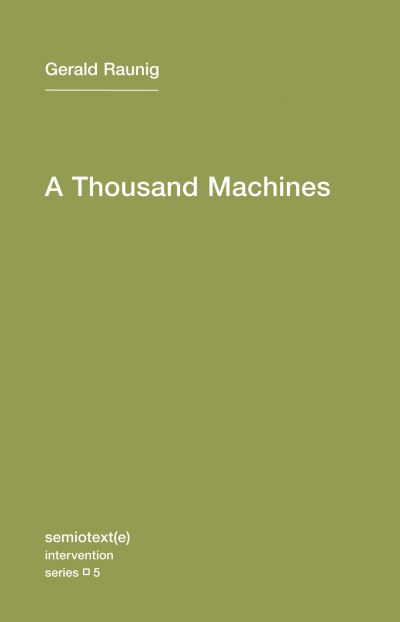
The machine as a social movement of today's "precariat"-those whose labor and lives are precarious.
In this "concise philosophy of the machine," Gerald Raunig provides a historical and critical backdrop to a concept proposed forty years ago by the French philosophers Félix Guattari and Gilles Deleuze: the machine, not as a technical device and apparatus, but as a social composition and concatenation. This conception of the machine as an arrangement of technical, bodily, intellectual, and social components subverts the opposition between man and machine, organism and mechanism, individual and community.
Drawing from an unusual range of films, literature, and performance-from the role of bicycles in Flann O'Brien's fiction to Vittorio de Sica's Neorealist film The Bicycle Thieves, and from Karl Marx's "Fragment on Machines" to the deus ex machina of Greek drama-Raunig arrives at an enhanced conception of the machine as a social movement, finding its most apt and concrete manifestation in the Euromayday movement, which since 2001 has become a transnational activist and discursive practice focused upon the precarious nature of labor and lives.
| ISBN: | 9781584350859 |
| Publication date: | 14th May 2010 |
| Author: | Gerald Raunig |
| Publisher: | Semiotext(e) |
| Format: | Paperback |
| Pagination: | 120 pages |
| Series: | Semiotext(e) Intervention Series |
| Genres: |
Social and political philosophy Industrial arbitration and negotiation |
This conception of the machine as an arrangement of technical, bodily, intellectual, and social components subverts the opposition between man and machine, organism and mechanism, individual and community. Drawing from an unusual range of films, literature, and performance-from the role of bicycles in Flann O'Brien's fiction to Vittorio de Sica's Neorealist film The Bicycle Thieves, and from Karl Marx's "Fragment on Machines" to the deus ex machina of Greek drama-Raunig arrives at an enhanced conception of the machine as a social movement, finding its most apt and concrete manifestation in the Euromayday movement, which since 2001 has become a transnational activist and discursive practice focused upon the precarious nature of labor and lives.
A Thousand Machines features in the following genres: Social and political philosophy, Industrial arbitration and negotiation
Paperback. Not Available.
A Thousand Machines was written by Gerald Raunig and published by Semiotext(e)
A Thousand Machines has 120 pages
Yes it is part of Semiotext(e) Intervention Series series