
10% off all books and free delivery over £50
Buy from our bookstore and 25% of the cover price will be given to a school of your choice to buy more books. *15% of eBooks.

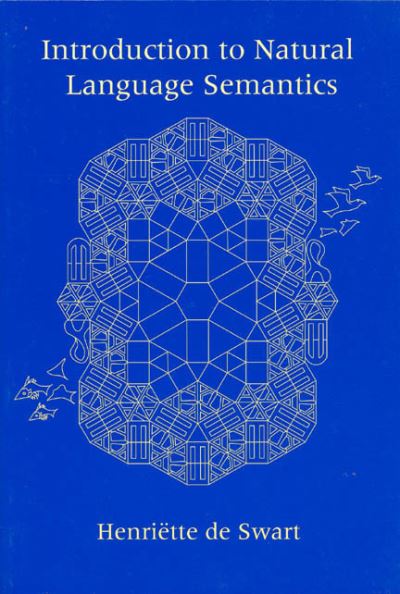
Introduction to Natural Language Semantics

View All Editions (2)

The selected edition of this book is not available to buy right now.
Add To Wishlist
Write A Review

About

Introduction to Natural Language Semantics Synopsis

Semantics is defined as the study of meaning expressed by elements of a language or combinations thereof. Utterances are not just noises or scribbles, they are used to convey information, and they are linked with kinds of events and with states of mind.

This text examines what issues semantics, as a theory of meaning, should address; determining what the meanings of words of the language are and how to semantically combine elements of a language to build up complex meanings. Logical languages are then developed as formal metalanguages to natural language. Subsequent chapters address propositional logic, the syntax and semantics of (first-order) predicate logic as an extension of propositional logic, and Generalized Quantifier theory. Going beyond extensional theory, Henri'tte de Swart relativizes the interpretation of expressions to times to account for verbal tense, time adverbials and temporal connectives and introduces possible worlds to model intensions, modal adverbs and modal auxiliaries.

This broad overview of natural language semantics should cover most of the points addressed in an introductory course. Numerous exercises punctuate each chapter and an example exam based on the materials presented is included, making this volume a perfect textbook and resource for any undergraduate or graduate-level introductory course in semantics.

About This Edition

ISBN: 9781575861395
Publication date:
Author: Henriëtte de Swart
Publisher: CSLI Publications an imprint of Center for the Study of Language and Inf
Format: Hardback
Pagination: 257 pages
Series: CSLI Lecture Notes
Genres: Semantics, discourse analysis, stylistics

Frequently asked questions