

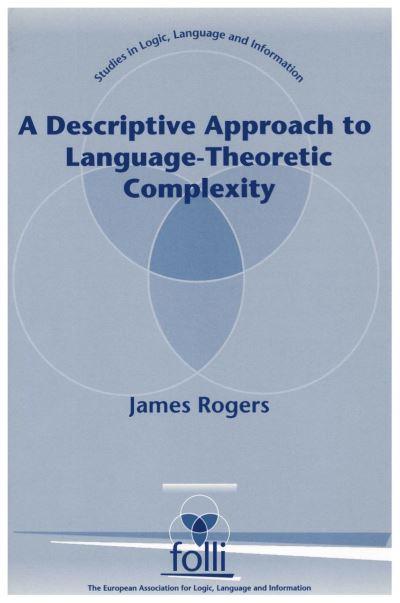
Early formal specifications of natural language syntax were quite closely connected to the notion of abstract machines for computing them. This provided a very natural means of gauging the relative difficulty of processing various constructions, as well as offering some insight into the abstract properties of the human language faculty. More recently, this approach has been superseded by one in which languages are specified in terms of systems of constraints on the structure of their sentences.
This has made complexity results difficult to obtain. This book introduces a way of obtaining such results. It presents a natural and quite general means of expressing constraints on the structure of trees and shows that the languages that can be specified by systems of such constraints are exactly those computable by a particular standard class of abstract machines.
Thus the difficulty of processing a construction can be reduced to the difficulty of expressing the constraints that specify it. The technique is demonstrated by applying it to a fairly complete treatment of English within the framework of Government and Binding theory, with the result of showing that its complexity is much less than has heretofore been assumed.
| ISBN: | 9781575861364 |
| Publication date: | 1st June 1998 |
| Author: | James Rogers |
| Publisher: | CSLI Publications an imprint of Center for the Study of Language and Inf |
| Format: | Paperback |
| Pagination: | 220 pages |
| Series: | Studies in Logic, Language and Information |
| Genres: |
Computational and corpus linguistics |
Early formal specifications of natural language syntax were quite closely connected to the notion of abstract machines for computing them. This provided a very natural means of gauging the relative difficulty of processing various constructions, as well as offering some insight into the abstract properties of the human language faculty.
A Descriptive Approach to Language-Theoretic Complexity features in the following genres: Computational and corpus linguistics
Paperback. Not Available.
A Descriptive Approach to Language-Theoretic Complexity was written by James Rogers and published by CSLI Publications an imprint of Center for the Study of Language and Inf
A Descriptive Approach to Language-Theoretic Complexity has 220 pages
Yes it is part of Studies in Logic, Language and Information series