

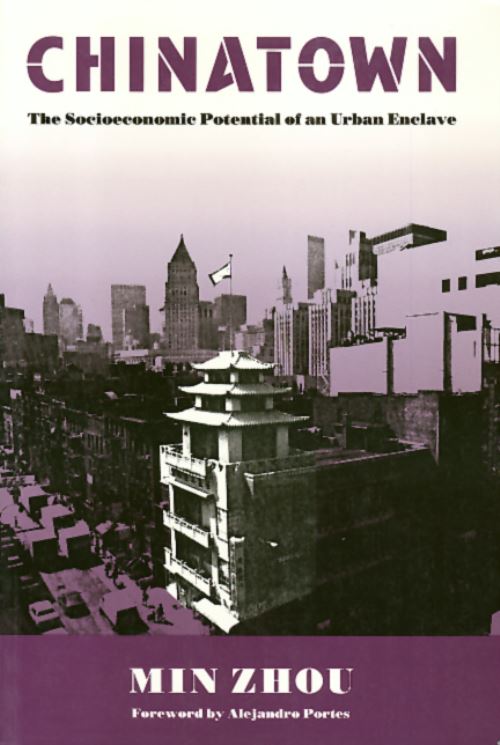
Min Zhou examines how an ethnic enclave works to direct its members into American society, while at the same time shielding them from it. Focusing specifically on New York's Chinatown, a community established more than a century ago, Zhou offers a thorough and modern treatment of the enclave as a socioeconomic system, distinct form, but intrinsically linked with, the larger society.Zhou's central theme is that Chinatown does not keep immigrant Chinese from assimilating into mainstream society, but instead provides an alternative means of incorporation into society that does not conflict with cultural distinctiveness.
Concentrating on the past two decades, Zhou maintains that community networks and social capital are important resources for reaching socioeconomic goals and social positions in the United States; in Chinatown, ethnic employers use family ties and ethnic resources to advance socially. Relying on her family's networks in New York's Chinatown and her fluency in both Cantonese and Mandarin, the author, who was born in the People's Republic of China, makes extensive use of personal interviews to present a rich picture of the daily work life in the community.
She demonstrates that for many immigrants, low-paid menial jobs provide by the enclave are expected as a part of the time-honored path to upward social mobility of the family.In the series Conflicts in Urban and Regional Development, edited by John R. Logan and Todd Swanstrom.
| ISBN: | 9781566393379 |
| Publication date: | 24th January 1995 |
| Author: | Min Zhou |
| Publisher: | Temple University Press |
| Format: | Paperback |
| Pagination: | 277 pages |
| Series: | Conflicts in Urban & Regional |
| Genres: |
Social and cultural history Ethnic studies Society and culture: general |
Min Zhou examines how an ethnic enclave works to direct its members into American society, while at the same time shielding them from it. Focusing specifically on New York's Chinatown, a community established more than a century ago, Zhou offers a thorough and modern treatment of the enclave as a socioeconomic system, distinct form, but intrinsically linked with, the larger society.Zhou's central theme is that Chinatown does not keep immigrant Chinese from assimilating into mainstream society, but instead provides an alternative means of incorporation into society that does not conflict with cultural distinctiveness.
Chinatown features in the following genres: Social and cultural history, Ethnic studies, Society and culture: general
Paperback. Not Available.
Chinatown was written by Min Zhou and published by Temple University Press
Chinatown has 277 pages
Yes it is part of Conflicts in Urban & Regional series