

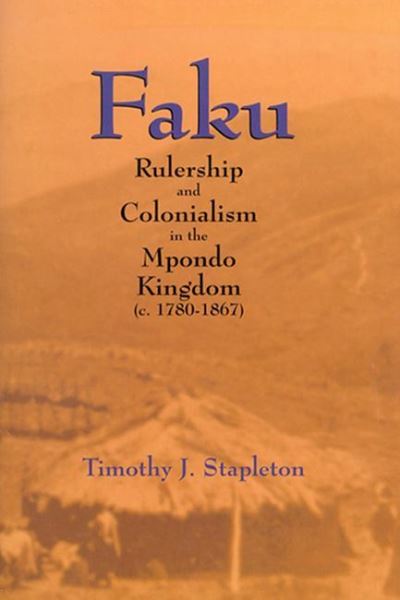
From roughly 1818 to 1867, Faku was ruler of the Mpondo Kingdom located in what is now the north-east section of the Eastern Cape, South Africa. Because of Faku's legacy, the Mpondo Kingdom became the last African state in Southern Africa to fall under colonial rule. When his father died, Faku inherited his power.
In a period of intense raiding, migration and state formation, he transformed the Mpondo polity from a loosely organized constellation of tributary groups to a centralized and populous state with effective military capabilities and a prosperous agricultural foundation. In 1830, Faku allowed Wesleyan missionaries to establish a station within his kingdom and they became his main channel of communication with the Cape Colony, and later Natal.
Ironically, he never showed any serious inclination to convert to Christianity. From the 1840s to early 1850s, this Mpondo king played a central, yet often understated, role in the British colonization of South Africa. While over the years his territory and power declined, Faku remained quite astute in diplomatic negotiations with colonial officials and used his missionary connections to optimum advantage.
Timothy J. Stapleton's narrative and use of oral history paint a clear and remarkable portrait of Faku and how he was able to manipulate missionaries, neighbours, colonists and circumstances to achieve his objectives. As a result, Faku: Rulership and Colonialism in the Mpondo Kingdom (c.1780-1867) helps illuminate the history of the entire Cape region.
| ISBN: | 9781554585939 |
| Publication date: | 30th April 2013 |
| Author: | Timothy J Stapleton |
| Publisher: | Wilfrid Laurier University Press |
| Format: | Paperback |
| Pagination: | 216 pages |
| Genres: |
African history Comparative politics |
From roughly 1818 to 1867, Faku was ruler of the Mpondo Kingdom located in what is now the north-east section of the Eastern Cape, South Africa. Because of Faku's legacy, the Mpondo Kingdom became the last African state in Southern Africa to fall under colonial rule.
Faku features in the following genres: African history, Comparative politics
Paperback. Not Available.
Faku was written by Timothy J Stapleton and published by Wilfrid Laurier University Press
Faku has 216 pages