

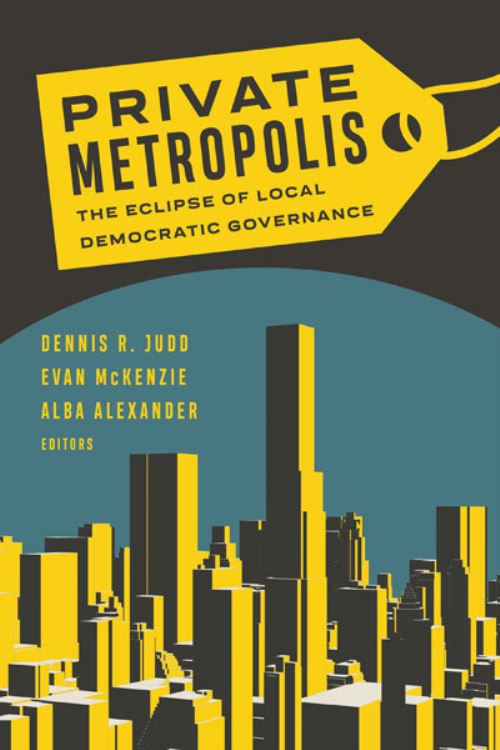
Examines the complex ecology of quasi-public and privatized institutions that mobilize and administer many of the political, administrative, and fiscal resources of today's metropolitan regions
In recent decades metropolitan regions in the United States have witnessed the rise of multitudes of "shadow governments" that often supersede or replace functions traditionally associated with municipalities and other local governments inherited from the urban past. Shadow governments take many forms, ranging from billion-dollar special authorities that span entire urban regions, to public-private partnerships and special districts created to accomplish particular tasks, to privatized gated communities, to neighborhood organizations empowered to receive private and public funds.
They finance and administer public services ranging from the prosaic (garbage collection and water utilities) to the transformative (economic development and infrastructure). Private Metropolis demonstrates that this complex ecosystem of local governance has compromised and even eclipsed democratic processes by moving important policy decisions out of public sight.
The quasi-public institutions of urban governance generally escape the budgetary and statutory restraints imposed on traditional local governments and protect policy decisions from the limitations and vagaries of electoral politics. Moving major policy decisions into a privatized and corporatized realm facilitates efficiency and speed, but at the cost of democratic oversight. Increasingly, the urban electorate is left debating symbolic issues only tangentially connected to the actual distribution of the resources that affect people's lives.
The essays in Private Metropolis grapple with the difficult and timely questions that arise from this new ecology of governance: What are the consequences of the proliferation of special authorities, privatized governments, and public-private arrangements? Is the trade-off between democratic accountability and efficiency worth it?
Has the public sector, with its messiness and inefficiencies-but also its checks and balances-ceded too much power to these new institutions? By examining such questions, this book provokes a long-overdue debate about the future of urban governance.
Contributors: Douglas Cantor, California State U, Long Beach; Ellen Dannin, Pennsylvania State U; Jameson W. Doig, Princeton U; Mary Donoghue; Peter Eisinger, New School; Steven P. Erie, U of California, San Diego; Rebecca Hendrick, U of Illinois at Chicago; Sara Hinkley, U of California, Berkeley; Amanda Kass, U of Illinois at Chicago; Scott A.
MacKenzie, U of California, Davis; David C. Perry, U of Illinois at Chicago; James M. Smith, U of Indiana South Bend; Shu Wang, Michigan State U; Rachel Weber, U of Illinois at Chicago.
| ISBN: | 9781517910822 |
| Publication date: | 22nd June 2021 |
| Author: | Alba Alexander |
| Publisher: | University of Minnesota Press an imprint of University Of Minnesota Press |
| Format: | Paperback |
| Pagination: | 312 pages |
| Series: | Globalization and Community |
| Genres: |
Regional, state and other local government Urban and municipal planning and policy Regional and area planning |
Examines the complex ecology of quasi-public and privatized institutions that mobilize and administer many of the political, administrative, and fiscal resources of today's metropolitan regionsIn recent decades metropolitan regions in the United States have witnessed the rise of multitudes of "shadow governments" that often supersede or replace functions traditionally associated with municipalities and other local governments inherited from the urban past. Shadow governments take many forms, ranging from billion-dollar special authorities that span entire urban regions, to public-private partnerships and special districts created to accomplish particular tasks, to privatized gated communities, to neighborhood organizations empowered to receive private and public funds.
Private Metropolis features in the following genres: Regional, state and other local government, Urban and municipal planning and policy, Regional and area planning
Paperback, Hardback. Not Available.
Private Metropolis was written by Alba Alexander and published by University of Minnesota Press an imprint of University Of Minnesota Press
Private Metropolis has 312 pages
Yes it is part of Globalization and Community series