

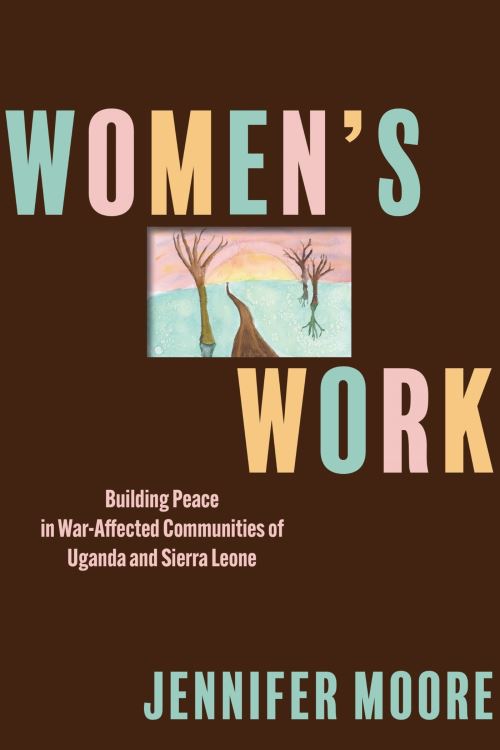
When women have full socioeconomic citizenship as well as equitable and respectful partnerships with men, transformative justice can be sustained in postconflict societies
In Women's Work, Jennifer Moore presents a reimagined theory of peacebuilding and transformative justice based on the experiences and insights of women farmers and microentrepreneurs who lived through protracted civil conflicts, drawing on seven years of interviews with women activists across ten communities-five in the Acholi region of Northern Uganda and five in the Moyamba and Koinadugu Districts of Sierra Leone. Despite the important differences between the preconflict and conflict histories and demographics of the two countries, Moore finds commonalities in the practical, yet visionary, approaches to community life emerging from the core values, daily activities, and long-range goals shared by rural cooperative members in both regions.
Collective survival, communal healing, and conflict resolution define the rhythm of these women's daily lives as they go about building peace, piecemeal. They reject punitive retribution models and demand, instead, a peacebuilding model that advocates for advances in material well-being, the acknowledgment of state accountability for community suffering, and reconciliation and restoration of community networks. But most important, Moore amplifies these women's voices when they insist that legal equality for women and healthy partnerships between women and men are also essential components to enduring transformation of their societies.
Moore theorizes what peacebuilding look like if it were modeled on these women-led, matriarchically structured communities that proved not only to be effective at holding governments accountable but also to have the capacity to feed their people and revitalize their local economies. Women's Work shows that when women have full socioeconomic citizenship as well as equitable and respectful partnerships with men, transformative justice can be sustained through the arts of collective livelihood, violence-free conflict management, and celebration.
| ISBN: | 9781512827279 |
| Publication date: | 11th March 2025 |
| Author: | Jennifer Moore |
| Publisher: | University of Pennsylvania Press |
| Format: | Paperback |
| Pagination: | 312 pages |
| Series: | Pennsylvania Studies in Human Rights |
| Genres: |
Peace studies and conflict resolution Social and cultural anthropology |
When women have full socioeconomic citizenship as well as equitable and respectful partnerships with men, transformative justice can be sustained in postconflict societies In Women's Work, Jennifer Moore presents a reimagined theory of peacebuilding and transformative justice based on the experiences and insights of women farmers and microentrepreneurs who lived through protracted civil conflicts, drawing on seven years of interviews with women activists across ten communities-five in the Acholi region of Northern Uganda and five in the Moyamba and Koinadugu Districts of Sierra Leone. Despite the important differences between the preconflict and conflict histories and demographics of the two countries, Moore finds commonalities in the practical, yet visionary, approaches to community life emerging from the core values, daily activities, and long-range goals shared by rural cooperative members in both regions.
Women's Work features in the following genres: Peace studies and conflict resolution, Social and cultural anthropology
Paperback, Hardback. Not Available.
Women's Work was written by Jennifer Moore and published by University of Pennsylvania Press
Women's Work has 312 pages
Yes it is part of Pennsylvania Studies in Human Rights series