

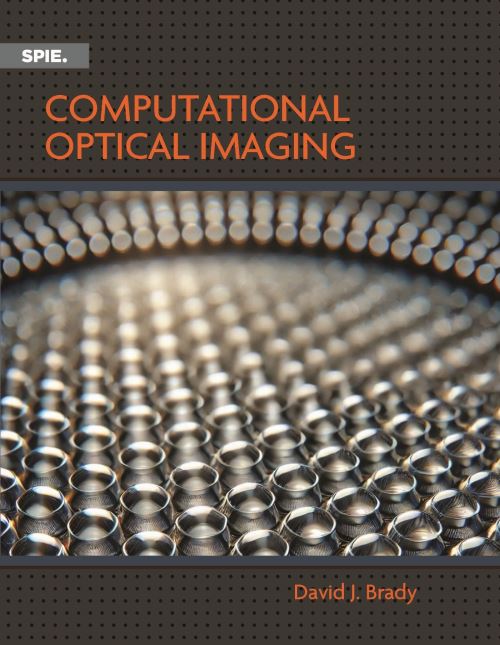
Computational optical imaging uses electromagnetic signals in the infrared, visible, ultraviolet, and x-ray wavelength ranges to characterize remote objects. This text explains how to create mathematical forward models describing tomographic, holographic, ptychographic, and photographic imaging systems. It describes image estimation algorithms, including those that use artificial neural networks and nonlinear estimators, to estimate still, video, and spectral images from measured data.
The text considers geometric, diffractive, and statistical optical radiation models. It shows that advanced sensing and estimation strategies allow optical imagers to resolve targets with resolution exceeding conventional limits. It also considers how to maximize measurement efficiency and imager capacity using coded and feature-specific sampling and physical system design.
Details not found in previous textbooks include coding strategies for compressive tomography, phase curvature in coherent imaging systems, the coherence transfer function, and interferometric focal planes. The last part of the book discusses digital camera design, including sampling optimization for photographic and video imaging and array camera design. This book focuses particularly on deep physical modeling of optical systems and algorithms.
It aims to fill the gap between detector design and high-level image processing and to give readers the tools to design end-to-end imaging systems.
| ISBN: | 9781510688919 |
| Publication date: | 27th January 2026 |
| Author: | David J Brady |
| Publisher: | SPIE an imprint of SPIE Press |
| Format: | Paperback |
| Series: | Press Monographs |
| Genres: |
Applied optics |
Computational optical imaging uses electromagnetic signals in the infrared, visible, ultraviolet, and x-ray wavelength ranges to characterize remote objects. This text explains how to create mathematical forward models describing tomographic, holographic, ptychographic, and photographic imaging systems.
Computational Optical Imaging features in the following genres: Applied optics
Paperback. £60.30, down from the £67.00 cover price. Not Available.
Computational Optical Imaging was written by David J Brady and published by SPIE an imprint of SPIE Press
Yes it is part of Press Monographs series
£60.30, reduced from £67.00. Not Available.