

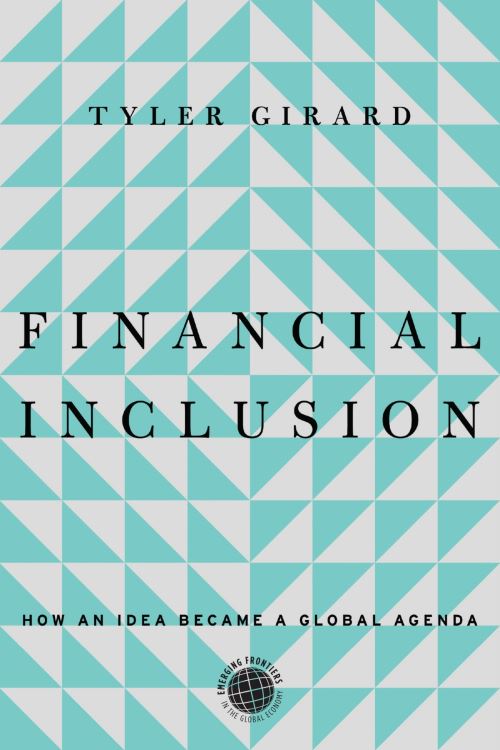
The number of people in the world with a bank account or money service provider increased by 2 billion over the past decade. This phenomenon reflects what Tyler Girard calls the global financial inclusion agenda. This agenda emerged in the wake of the 2008 financial crisis and quickly became a prominent feature of global economic governance. The core idea of financial inclusion is that all individuals and businesses should have access to and use formal financial services, including bank accounts, payment services, credit, and insurance. Today, the widespread ability to digitally store and transfer money has impacted every aspect of our lives. What explains the emergence and evolution of the global financial inclusion agenda? And what does the politics of the agenda tell us about the impacts of new technologies on global politics and how ideas become global agendas? Drawing on an original collection of primary documents and interviews with elites from Ghana, the United Kingdom, the United States, and Switzerland, this book traces the global financial inclusion agenda over time and interrogates its adaptation in specific contexts and issue areas. Through the concept of participatory ambiguity, Girard offers a novel explanation of the agenda that advances important debates in international relations and international political economy on the distribution of power and authority in global governance.
| ISBN: | 9781503645172 |
| Publication date: | 12th May 2026 |
| Author: | Tyler Girard |
| Publisher: | Stanford University Press |
| Format: | Hardback |
| Pagination: | 284 pages |
| Series: | Emerging Frontiers in the Global Economy |
| Genres: |
Political economy International relations Development economics and emerging economies |
The number of people in the world with a bank account or money service provider increased by 2 billion over the past decade. This phenomenon reflects what Tyler Girard calls the global financial inclusion agenda.
Financial Inclusion features in the following genres: Political economy, International relations, Development economics and emerging economies
Hardback. Not Available.
Financial Inclusion was written by Tyler Girard and published by Stanford University Press
Financial Inclusion has 284 pages
Yes it is part of Emerging Frontiers in the Global Economy series