

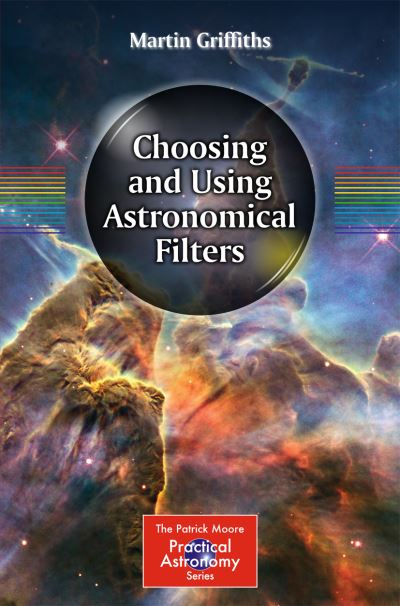
As a casual read through any of the major amateur astronomical magazines will demonstrate, there are filters available for all aspects of optical astronomy. This book provides a ready resource on the use of the following filters, among others, for observational astronomy or for imaging:
Deep-sky objects can be imaged in much greater detail than was possible many years ago. Amateur astronomers can take photographs that rival those of professional observatories! The ability to do this has been brought about by the revolution in CCD cameras and improved filters.
The book pinpoints which astronomical objects are best observed with which filters. Post-processing (using Photoshop) is also discussed, since it is helpful in further improving filtered astro images.
The last part of the book is an observational guide to 100 deep sky objects that benefit from the use of filters - all personally observed by the author - with notes on the filters used (or potentially of use) in their observation and imaging. There are also notes on their celestial coordinates, magnitudes and other pertinent information.
| ISBN: | 9781493910434 |
| Publication date: | 21st June 2014 |
| Author: | Martin Griffiths |
| Publisher: | Springer an imprint of Springer New York |
| Format: | Paperback |
| Pagination: | 269 pages |
| Series: | The Patrick Moore Practical Astronomy Series |
| Genres: |
Astronomical observation: observatories, equipment and methods Electricity, electromagnetism and magnetism Electronics engineering Digital signal processing (DSP) Astronomy, space and time |
As a casual read through any of the major amateur astronomical magazines will demonstrate, there are filters available for all aspects of optical astronomy. This book provides a ready resource on the use of the following filters, among others, for observational astronomy or for imaging:Light pollution filtersPlanetary filtersSolar filtersNeutral density filters for Moon observationDeep-sky filters, for such objects as galaxies, nebulae and moreDeep-sky objects can be imaged in much greater detail than was possible many years ago.
Choosing and Using Astronomical Filters features in the following genres: Astronomical observation: observatories, equipment and methods, Electricity, electromagnetism and magnetism, Electronics engineering, Digital signal processing (DSP), Astronomy, space and time
Paperback, Ebook. £40.49, down from the £44.99 cover price. Not Available.
Choosing and Using Astronomical Filters was written by Martin Griffiths and published by Springer an imprint of Springer New York
Choosing and Using Astronomical Filters has 269 pages
Yes it is part of The Patrick Moore Practical Astronomy Series series
£40.49, reduced from £44.99. Not Available.