

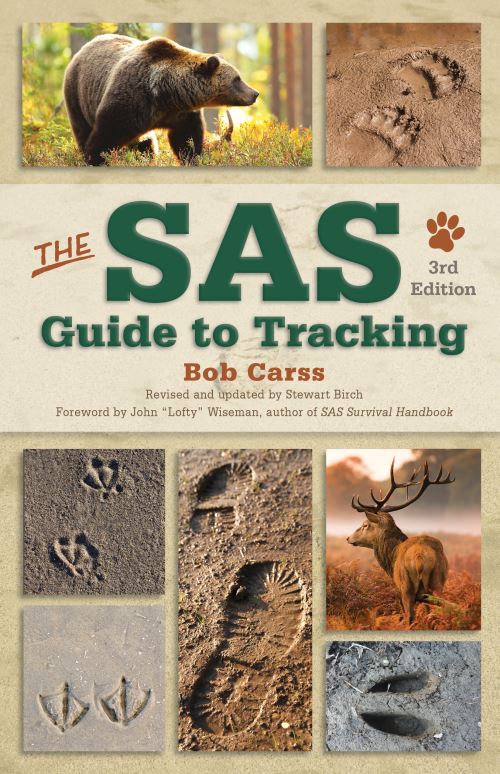
Anyone who has spent even a little time outdoors has come across strange tracks left by animals or people and wondered, "What was here?" In this practical guide, former-SAS member Bob Carss shows how to track any moving thing, in any environment, and under nearly any circumstance. He begins by explaining common terms, such as a "top sign", markings left above ankle height; "pointers", signs that tell the general direction of the quarry; and a "conclusive sign," markings that confirm the quarry's presence.
The difference between tracks left by quarry and false tracks are described, as well as how a pattern of signs builds into the tracking picture - the overall movement, direction, and motivation of the quarry. Included are tips on: ·Tracking in desert, forest, jungle, marsh, and grassy areas ·Interpreting animal, human, and vehicle signs ·How to preserve night vision ·Using time frames to eliminate misleading signs ·Detecting quarry when they backtrack or circle around ·How time and weather affect signs ·How to spot intentionally misleading signs The SAS Guide to Tracking is a remarkable guide to developing a new awareness of the outdoors and is the perfect companion for naturalists, outdoorspeople, hunters, wildlife photographers, search-and-rescue teams, and law enforcement.
| ISBN: | 9781493044306 |
| Publication date: | 1st April 2020 |
| Author: | Bob Carss, Stewart Birch |
| Illustrator: | Roy Thomasson |
| Publisher: | The Lyons Press an imprint of Lyons Press |
| Format: | Paperback |
| Pagination: | 400 pages |
| Series: | SAS |
| Genres: |
Special and elite forces Military history |
Anyone who has spent even a little time outdoors has come across strange tracks left by animals or people and wondered, "What was here?" In this practical guide, former-SAS member Bob Carss shows how to track any moving thing, in any environment, and under nearly any circumstance. He begins by explaining common terms, such as a "top sign", markings left above ankle height; "pointers", signs that tell the general direction of the quarry; and a "conclusive sign," markings that confirm the quarry's presence. The difference between tracks left by quarry and false tracks are described, as well as how a pattern of signs builds into the tracking picture - the overall movement, direction, and motivation of the quarry. Included are tips on: ·Tracking in desert, forest, jungle, marsh, and grassy areas ·Interpreting animal, human, and vehicle signs ·How to preserve night vision ·Using time frames to eliminate misleading signs ·Detecting quarry when they backtrack or circle around ·How time and weather affect signs ·How to spot intentionally misleading signs The SAS Guide to Tracking is a remarkable guide to developing a new awareness of the outdoors and is the perfect companion for naturalists, outdoorspeople, hunters, wildlife photographers, search-and-rescue teams, and law enforcement.
The SAS Guide to Tracking features in the following genres: Special and elite forces, Military history
Paperback. Not Available.
The SAS Guide to Tracking was written by Bob Carss, Stewart Birch and published by The Lyons Press an imprint of Lyons Press
The SAS Guide to Tracking has 400 pages
Yes it is part of SAS series