

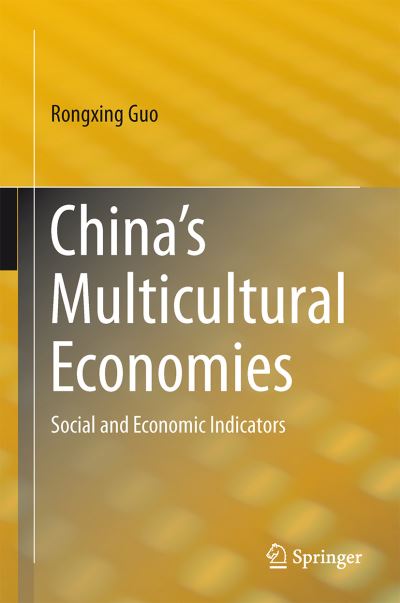
Although the majority of China's population is of the Han nationality (which accounts for more than 90% of China's population), the non-Han ethnic groups have a population of more than 100 million. Until now, China has officially identified, except for other unknown ethnic groups and foreigners with Chinese citizenship, 56 ethnic groups. In addition, ethnic groups vary widely in size. With a population of more than 15 million, the Zhuang have the largest ethnic minority, and the Lhoba, with only two thousand or more, the smallest. China's ethnic diversity has resulted in a special socioeconomic landscape of China itself. This book develops a complete socioeconomic picture and a detailed and comparable set of data for each of China's ethnic groups. There have not been any precise data on China's socioeconomic statistics from multi-ethnic dimension. The only official data released can be found in China Ethnic Statistical Yearbook (released by the State Commission of Ethnic Affairs (SCEA) of the People's Republic of China since 1994). However, as this Yearbook has only reported the socioeconomic statistics for the minority-based autonomous areas, a complete set of China's multi-ethnic data cannot be derived from it. This book provides a broad collection of data on China's 56 ethnic groups and profiles the demography, cultural, economy, and business climates for each of China's diverse ethnic groups.
| ISBN: | 9781489985828 |
| Publication date: | 13th December 2014 |
| Author: | Rongxing Guo |
| Publisher: | Springer an imprint of Springer US |
| Format: | Paperback |
| Pagination: | 198 pages |
| Genres: |
Political science and theory Population and demography Sociology |
Although the majority of China's population is of the Han nationality (which accounts for more than 90% of China's population), the non-Han ethnic groups have a population of more than 100 million. Until now, China has officially identified, except for other unknown ethnic groups and foreigners with Chinese citizenship, 56 ethnic groups. In addition, ethnic groups vary widely in size. With a population of more than 15 million, the Zhuang have the largest ethnic minority, and the Lhoba, with only two thousand or more, the smallest. China's ethnic diversity has resulted in a special socioeconomic landscape of China itself. This book develops a complete socioeconomic picture and a detailed and comparable set of data for each of China's ethnic groups. There have not been any precise data on China's socioeconomic statistics from multi-ethnic dimension. The only official data released can be found in China Ethnic Statistical Yearbook (released by the State Commission of Ethnic Affairs (SCEA) of the People's Republic of China since 1994). However, as this Yearbook has only reported the socioeconomic statistics for the minority-based autonomous areas, a complete set of China's multi-ethnic data cannot be derived from it. This book provides a broad collection of data on China's 56 ethnic groups and profiles the demography, cultural, economy, and business climates for each of China's diverse ethnic groups.
China's Multicultural Economies features in the following genres: Political science and theory, Population and demography, Sociology
China's Multicultural Economies is available in Paperback, Ebook, Hardback
China's Multicultural Economies was written by Rongxing Guo and published by Springer an imprint of Springer US
China's Multicultural Economies has 198 pages