

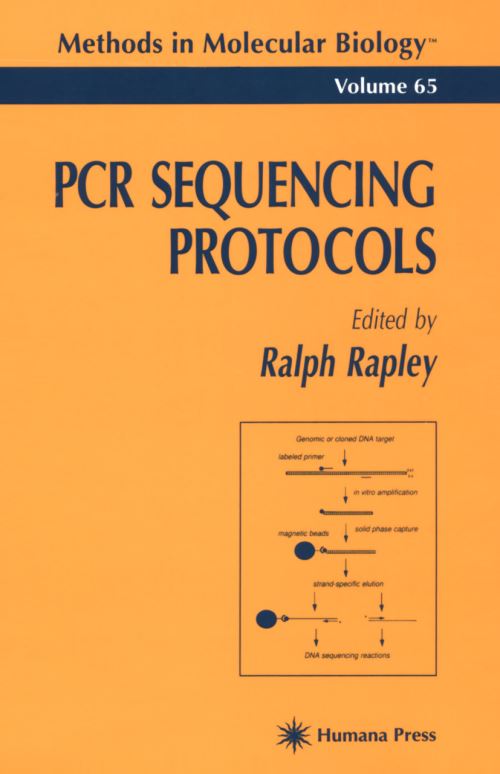
Advances in bioscience research usually arise as a result of the continu- ing refinement of existing technologies. However, there are a number of occa- sions v^rhere newly developed methodologies have a profound effect on nearly all areas of research. Frequently these are techniques that are elegantly simple in concept and require minimal technical manipulation.
Two of these revolu- tionary techniques are the focus ofPCR Sequencing Protocols. The first such technique is enzymatic chain termination sequencing developed by Sanger and his co-workers in Cambridge and reported in 1977. This essentially brought the possibility of deriving nucleotide sequence information in a very short time scale and has been widely accepted in many laboratories as a routine molecular biological research tool.
Furthermore, it has not only led to the sequencing of many genes and gene fragments, but has also allowed the tech- nical means of sequencing the human genome. The second technique that has found widespread acceptance in basic applied research and many routine applications is the polymerase chain reac- tion. This technique, first reported in 1985 by MuUis and his colleagues, pro- vides the means to amplify nucleic acid sequence, which immediately proved invaluable in nearly all fields of biological laboratory research.
Here, as with enzymatic DNA sequencing, is a very simple concept that relies on minimal information to prepare short oligonucleotide primers that direct the synthesis of a specified fi-agment o f DNA in the presence of a thermostable DNA polymerase.
| ISBN: | 9781489940384 |
| Publication date: | 13th August 2013 |
| Author: | Ralph Rapley |
| Publisher: | Humana Press |
| Format: | Paperback |
| Pagination: | 221 pages |
| Series: | Methods in Molecular Biology |
| Genres: |
Cellular biology (cytology) |
Advances in bioscience research usually arise as a result of the continu- ing refinement of existing technologies. However, there are a number of occa- sions v^rhere newly developed methodologies have a profound effect on nearly all areas of research.
PCR Sequencing Protocols features in the following genres: Cellular biology (cytology)
Paperback, Spiral bound. £80.99, down from the £89.99 cover price. Not Available.
PCR Sequencing Protocols was written by Ralph Rapley and published by Humana Press
PCR Sequencing Protocols has 221 pages
Yes it is part of Methods in Molecular Biology series
£80.99, reduced from £89.99. Not Available.