

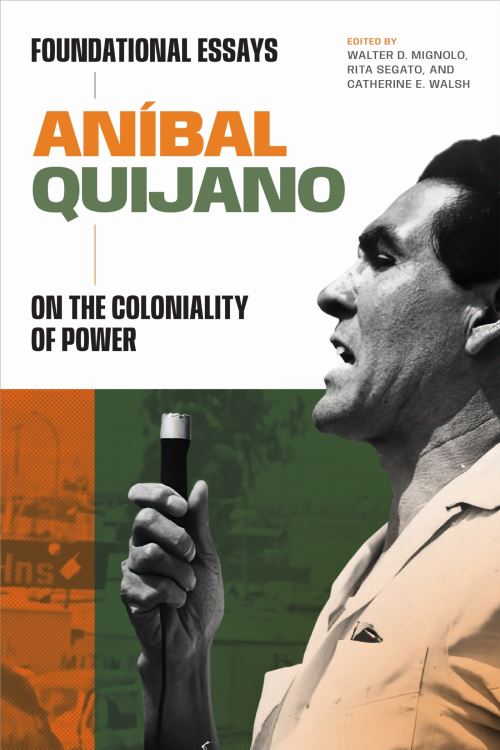
The Peruvian sociologist AnÍbal Quijano is widely considered to be a foundational figure of the decolonial perspective grounded in three basic concepts: coloniality, coloniality of power, and the colonial matrix of power. His decolonial theorizations of these three concepts have transformed the principles and assumptions of the very idea of knowledge, impacted the social sciences and humanities, and questioned the myth of rationality in natural sciences.
The essays in this volume encompass nearly thirty years of Quijano's work, bringing them to an English-reading audience for the first time. This volume is not simply an introduction to Quijano's work; it achieves one of his unfulfilled goals: to write a book that contains his main hypotheses, concepts, and arguments. In this regard, the collection encourages a fuller understanding and broader implementation of the analyses and concepts that he developed over the course of his long career.
Moreover, it demonstrates that the tools for reading and dismantling coloniality originated outside the academy in Latin America and the former Third World.
| ISBN: | 9781478026099 |
| Publication date: | 5th April 2024 |
| Author: | Aníbal Quijano |
| Publisher: | Duke University Press |
| Format: | Hardback |
| Pagination: | 485 pages |
| Series: | On Decoloniality |
| Genres: |
Social and political philosophy |
The Peruvian sociologist AnÍbal Quijano is widely considered to be a foundational figure of the decolonial perspective grounded in three basic concepts: coloniality, coloniality of power, and the colonial matrix of power. His decolonial theorizations of these three concepts have transformed the principles and assumptions of the very idea of knowledge, impacted the social sciences and humanities, and questioned the myth of rationality in natural sciences.
Aníbal Quijano features in the following genres: Social and political philosophy
Hardback, Paperback. Not Available.
Aníbal Quijano was written by Aníbal Quijano and published by Duke University Press
Aníbal Quijano has 485 pages
Yes it is part of On Decoloniality series