

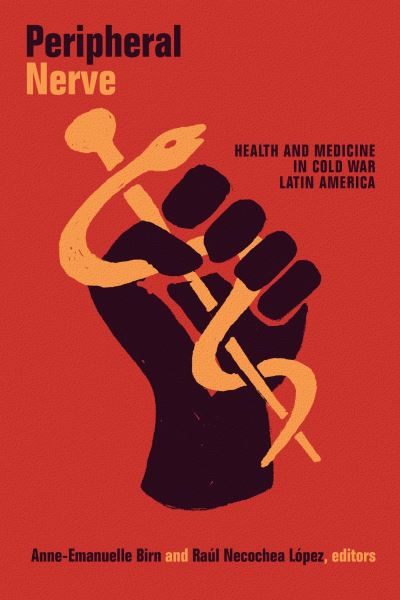
Buenos Aires psychoanalysts resisting imperialism. Brazilian parasitologists embracing communism as an antidote to rural misery. Nicaraguan revolutionaries welcoming Cuban health cooperation. Chilean public health reformers gauging domestic approaches against their Soviet and Western counterparts. As explored in Peripheral Nerve, these and accompanying accounts problematize existing understandings of how the Cold War unfolded in Latin America generally and in the health and medical realms more specifically.
Bringing together scholars from across the Americas, this volume chronicles the experiences of Latin American physicians, nurses, medical scientists, and reformers who interacted with dominant U.S. and European players and sought alternative channels of health and medical solidarity with the Soviet Union and via South-South cooperation.
Throughout, Peripheral Nerve highlights how Latin American health professionals accepted, rejected, and adapted foreign involvement; manipulated the rivalry between the United States and the USSR; and forged local variants that they projected internationally. In so doing, this collection reveals the multivalent nature of Latin American health politics, offering a significant contribution to Cold War history.
Contributors. Cheasty Anderson, Anne-Emanuelle Birn, Katherine E. Bliss, Gilberto Hochman, Jennifer L. Lambe, Nicole Pacino, Carlos Henrique AssunǦo Paiva, Jadwiga E. Pieper Mooney, RaTl Necochea Lapez, Marco A. Ramos, Gabriela Soto Laveaga
| ISBN: | 9781478009566 |
| Publication date: | 14th August 2020 |
| Author: | AnneEmanuelle Birn, Raúl Necochea López |
| Publisher: | Duke University Press |
| Format: | Paperback |
| Pagination: | 376 pages |
| Series: | American Encounters/global Interactions |
| Genres: |
Public health and preventive medicine History of the Americas |
Buenos Aires psychoanalysts resisting imperialism. Brazilian parasitologists embracing communism as an antidote to rural misery.
Peripheral Nerve features in the following genres: Public health and preventive medicine, History of the Americas
Paperback, Hardback. Not Available.
Peripheral Nerve was written by AnneEmanuelle Birn, Raúl Necochea López and published by Duke University Press
Peripheral Nerve has 376 pages
Yes it is part of American Encounters/global Interactions series