

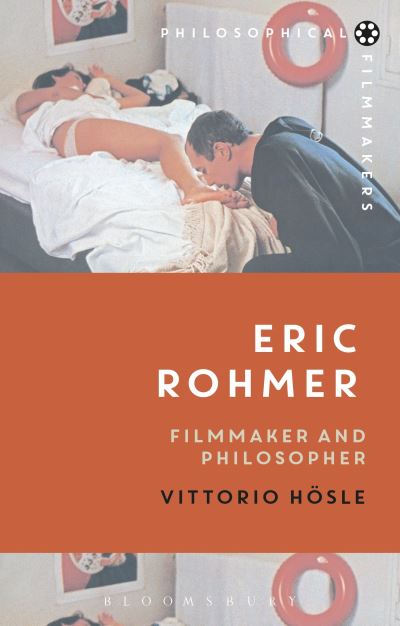
Rohmer is one of the most popular French directors of the second half of the 20th century, one of the members of the famous Nouvelle Vague that reconstituted French cinema based on the theoretical principles articulated in the Cahiers du Cinéma - from whose editorship he was fired when the conservative Catholic opposed its turn toward politicization. Like some of his colleagues, Rohmer is extremely interested in both the history and the philosophy of film: Brother of the noted French philosopher René Scherer, he begins his career as a film critic In his films, deep moral conflicts as well as the search for one's own identity emerge from the intricacies of seemingly superficial everyday life interactions, particularly between a man and a woman.
Hösle's book puts Rohmer in the context of a long French tradition of reflected eroticism, with Marivaux, Musset, Stendhal, and Jean Renoir as crucial figures, and shows how Rohmer both recognizes the inner logic of eroticism and subjects it to moral demands that he inherits from his Catholic background. For Rohmer, the tension between the two can usually only be solved by some unexpected event that can be interpreted as an equivalent of grace.
| ISBN: | 9781474221122 |
| Publication date: | 28th July 2016 |
| Author: | Vittorio Hösle |
| Publisher: | Bloomsbury Academic an imprint of Bloomsbury Publishing (UK) |
| Format: | Paperback |
| Pagination: | 216 pages |
| Series: | Philosophical Filmmakers |
| Genres: |
Individual film directors, film-makers Western philosophy from c 1800 Philosophy: aesthetics Film history, theory or criticism Philosophy |
Rohmer is one of the most popular French directors of the second half of the 20th century, one of the members of the famous Nouvelle Vague that reconstituted French cinema based on the theoretical principles articulated in the Cahiers du Cinéma - from whose editorship he was fired when the conservative Catholic opposed its turn toward politicization. Like some of his colleagues, Rohmer is extremely interested in both the history and the philosophy of film: Brother of the noted French philosopher René Scherer, he begins his career as a film critic In his films, deep moral conflicts as well as the search for one's own identity emerge from the intricacies of seemingly superficial everyday life interactions, particularly between a man and a woman.
Eric Rohmer features in the following genres: Individual film directors, film-makers, Western philosophy from c 1800, Philosophy: aesthetics, Film history, theory or criticism, Philosophy
Paperback. Not Available.
Eric Rohmer was written by Vittorio Hösle and published by Bloomsbury Academic an imprint of Bloomsbury Publishing (UK)
Eric Rohmer has 216 pages
Yes it is part of Philosophical Filmmakers series