

This book is available as open access through the Bloomsbury Open Access programme and is available on www.bloomsburycollections.com.
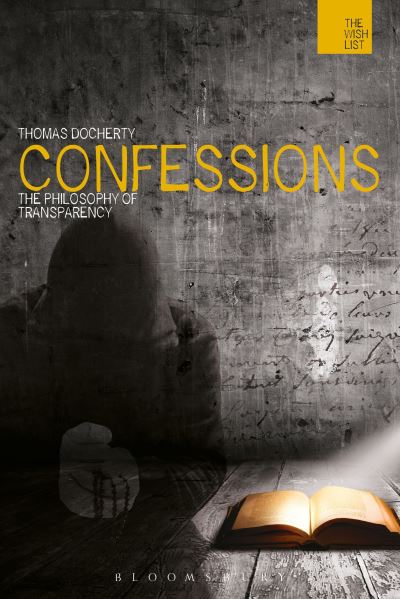
This book explores what is at stake in our confessional culture. Thomas Docherty examines confessional writings from Augustine to Montaigne and from Sylvia Plath to Derrida, arguing that through all this work runs a philosophical substratum - the conditions under which it is possible to assert a confessional mode - that needs exploration and explication.
Docherty outlines a philosophy of confession that has pertinence for a contemporary political culture based on the notion of 'transparency'. In a postmodern 'transparent society', the self coincides with its self-representations. Such a position is central to the idea of authenticity and truth-telling in confessional writing: it is the basis of saying, truthfully, 'here I take my stand'.
The question is: what other consequences might there be of an assumption of the primacy of transparency? Two areas are examined in detail: the religious and the judicial. Docherty shows that despite the tendency to regard transparency as a general social and ethical good, our contemporary culture of transparency has engendered a society in which autonomy (or the very authority of the subject that proclaims 'I confess') is grounded in guilt, reparation and victimhood.
| ISBN: | 9781472557452 |
| Publication date: | 16th January 2014 |
| Author: | Thomas Docherty |
| Publisher: | Bloomsbury Academic an imprint of Bloomsbury Publishing (UK) |
| Format: | Paperback |
| Pagination: | 224 pages |
| Series: | The WISH List |
| Genres: |
Literary studies: general History of ideas Ethics and moral philosophy |
This book is available as open access through the Bloomsbury Open Access programme and is available on www.bloomsburycollections.com.This book explores what is at stake in our confessional culture. Thomas Docherty examines confessional writings from Augustine to Montaigne and from Sylvia Plath to Derrida, arguing that through all this work runs a philosophical substratum - the conditions under which it is possible to assert a confessional mode - that needs exploration and explication.
Confessions features in the following genres: Literary studies: general, History of ideas, Ethics and moral philosophy
Paperback. Not Available.
Confessions was written by Thomas Docherty and published by Bloomsbury Academic an imprint of Bloomsbury Publishing (UK)
Confessions has 224 pages
Yes it is part of The WISH List series