

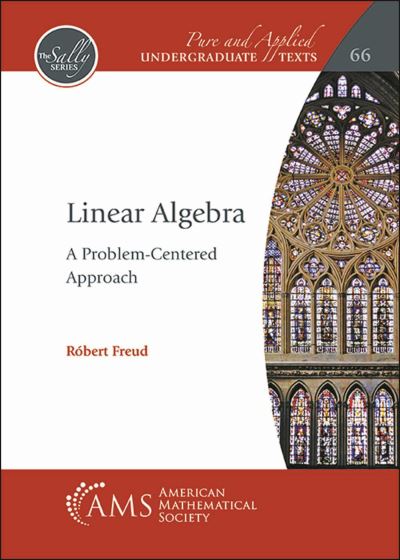
This textbook invites readers to dive into the mathematical ideas of linear algebra. Offering a gradual yet rigorous introduction, the author illuminates the structure, order, symmetry, and beauty of the topic. Opportunities to explore, master, and extend the theory abound, with generous exercise sets embodying the Hungarian tradition of active problem-solving.
Determinants, matrices, and systems of linear equations begin the book. This unique ordering offers insights from determinants early on, while also admitting re-ordering if desired. Chapters on vector spaces, linear maps, and eigenvalues and eigenvectors follow.
Bilinear functions and Euclidean spaces build on the foundations laid in the first half of the book to round out the core material. Applications in combinatorics include Hilbert's third problem, Oddtown and Eventown problems, and Sidon sets, a favorite of Paul Erdos. Coding theory applications include error-correction, linear, Hamming, and BCH codes.
An appendix covers the algebraic basics used in the text. Ideal for students majoring in mathematics and computer science, this textbook promotes a deep and versatile understanding of linear algebra. Familiarity with mathematical proof is assumed, though no prior knowledge of linear algebra is needed.
Supplementary electronic materials support teaching and learning, with selected answers, hints, and solutions, and an additional problem bank for instructors.
| ISBN: | 9781470477363 |
| Publication date: | 31st December 2024 |
| Author: | Róbert Freud |
| Publisher: | American Mathematical Society |
| Format: | Paperback |
| Pagination: | 305 pages |
| Series: | Pure and Applied Undergraduate Texts |
| Genres: |
Algebra Algebraic geometry |
This textbook invites readers to dive into the mathematical ideas of linear algebra. Offering a gradual yet rigorous introduction, the author illuminates the structure, order, symmetry, and beauty of the topic.
Linear Algebra features in the following genres: Algebra, Algebraic geometry
Paperback. Not Available.
Linear Algebra was written by Róbert Freud and published by American Mathematical Society
Linear Algebra has 305 pages
Yes it is part of Pure and Applied Undergraduate Texts series