

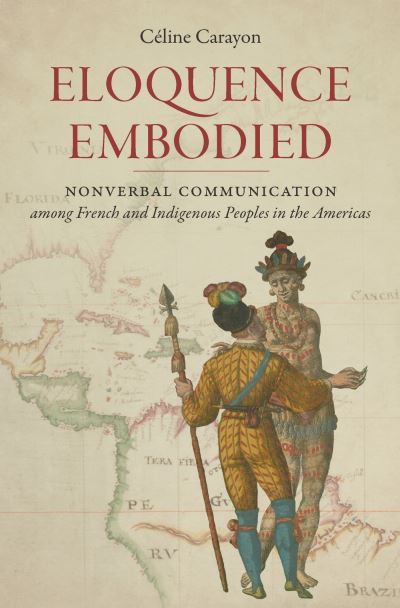
Taking a fresh look at the first two centuries of French colonialism in the Americas, this book answers the long-standing question of how and how well Indigenous Americans and the Europeans who arrived on their shores communicated with each other. French explorers and colonists in the sixteenth century noticed that Indigenous peoples from Brazil to Canada used signs to communicate. The French, in response, quickly embraced the nonverbal as a means to overcome cultural and language barriers. Céline Carayon's close examination of their accounts enables her to recover these sophisticated Native practices of embodied expressions.
In a colonial world where communication and trust were essential but complicated by a multitude of languages, intimate and sensory expressions ensured that French colonists and Indigenous peoples understood each other well. Understanding, in turn, bred both genuine personal bonds and violent antagonisms. As Carayon demonstrates, nonverbal communication shaped Indigenous responses and resistance to colonial pressures across the Americas just as it fueled the imperial French imagination. Challenging the notion of colonial America as a site of misunderstandings and insurmountable cultural clashes, Carayon shows that Natives and newcomers used nonverbal means to build relationships before the rise of linguistic fluency - and, crucially, well afterward.
| ISBN: | 9781469699080 |
| Publication date: | 1st August 2026 |
| Author: | Céline Carayon |
| Publisher: | Omohundro Institute and UNC Press an imprint of The University of North Carolina Press |
| Format: | Paperback |
| Pagination: | 472 pages |
| Series: | Published by the Omohundro Institute of Early American History and Culture and the University of North Carolina Press |
| Genres: |
History of the Americas Indigenous peoples Social and cultural history European history |
Taking a fresh look at the first two centuries of French colonialism in the Americas, this book answers the long-standing question of how and how well Indigenous Americans and the Europeans who arrived on their shores communicated with each other. French explorers and colonists in the sixteenth century noticed that Indigenous peoples from Brazil to Canada used signs to communicate. The French, in response, quickly embraced the nonverbal as a means to overcome cultural and language barriers. Céline Carayon's close examination of their accounts enables her to recover these sophisticated Native practices of embodied expressions.
In a colonial world where communication and trust were essential but complicated by a multitude of languages, intimate and sensory expressions ensured that French colonists and Indigenous peoples understood each other well. Understanding, in turn, bred both genuine personal bonds and violent antagonisms. As Carayon demonstrates, nonverbal communication shaped Indigenous responses and resistance to colonial pressures across the Americas just as it fueled the imperial French imagination. Challenging the notion of colonial America as a site of misunderstandings and insurmountable cultural clashes, Carayon shows that Natives and newcomers used nonverbal means to build relationships before the rise of linguistic fluency - and, crucially, well afterward.
Eloquence Embodied features in the following genres: History of the Americas, Indigenous peoples, Social and cultural history, European history
Eloquence Embodied is available in Paperback, Hardback
Eloquence Embodied was written by Céline Carayon and published by Omohundro Institute and UNC Press an imprint of The University of North Carolina Press
Eloquence Embodied has 472 pages
£27.90