

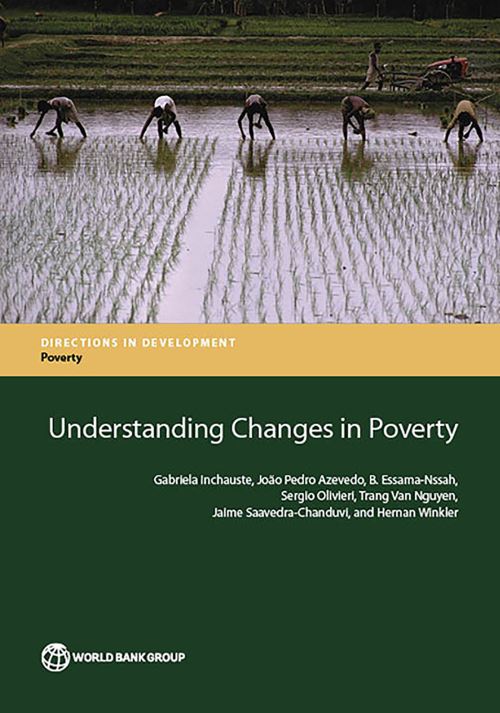
The 2015 Millennium Development Goal to reduce by 50 percent the share of the world's population living in extreme poverty was met early. The number of individuals in developing countries who live in extreme poverty had decreased from 43 percent in 1990 to 21 percent by 2010. Yet, with 1.2 billion people still struggling today, we have a long way to go.
What can we learn from the recent success of reducing extreme poverty? Understanding Changes in Poverty brings together different methods to decompose the contributions to poverty reduction. A simple approach quantifies the contribution of changes in demographics, employment, earnings, public transfers, and remittances to poverty reduction.
A more complex approach quantifies the contributions to poverty reduction from changes in individual and household characteristics, including changes in the sectoral, occupational, and educational structure of the workforce, as well as changes in the returns to individual and household characteristics. Understanding Changes in Poverty implements these approaches and finds that labor income growth-that is, growth in income per worker rather than an increase in the number of employed workers-was the largest contributor to moderate poverty reduction in 21 countries experiencing substantial reductions in poverty over the past decade.
Changes in demographics, public transfers, and remittances helped, but made relatively smaller contributions to poverty reduction. Further decompositions in three countries find that labor income grew mainly because of higher returns to human capital endowments, signaling increases in productivity, higher relative price of labor, or both. Understanding Changes in Poverty will be of particular relevance to development practitioners interested in better understanding distributional changes over time.
The methods and tools presented in this book can also be applied to better understand changes in inequality or any other distributional change.
| ISBN: | 9781464802997 |
| Publication date: | 30th August 2014 |
| Author: | Gabriela Inchauste |
| Publisher: | World Bank Publications an imprint of The World Bank |
| Format: | Paperback |
| Pagination: | 188 pages |
| Series: | Directions in Development: Poverty |
| Genres: |
Society and culture: general |
The 2015 Millennium Development Goal to reduce by 50 percent the share of the world's population living in extreme poverty was met early. The number of individuals in developing countries who live in extreme poverty had decreased from 43 percent in 1990 to 21 percent by 2010.
Understanding Changes in Poverty features in the following genres: Society and culture: general
Paperback. Not Available.
Understanding Changes in Poverty was written by Gabriela Inchauste and published by World Bank Publications an imprint of The World Bank
Understanding Changes in Poverty has 188 pages
Yes it is part of Directions in Development: Poverty series