

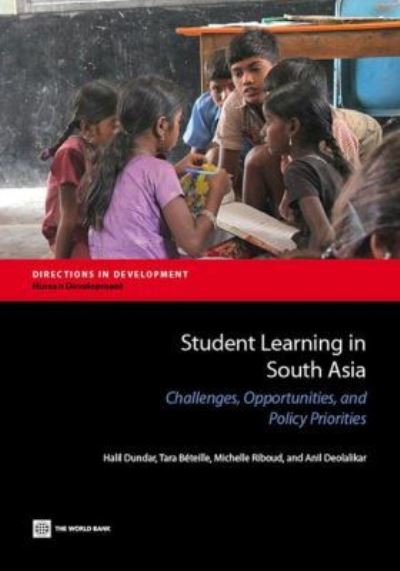
For the past decade, most South Asian countries have directed their efforts towards achieving universal access to elementary education. While these investments have led to more children being retained in school, they have not translated into better learning outcomes. This report comprehensively analyzes the performance of South Asian educational systems in terms of student learning.
It attempts to answer three questions: How well do education systems in South Asia perform? What determines student learning outcomes? What policy options are effective in improving learning outcomes, especially given increasing demand and competition for public resources?
Because learning outcomes and skill acquisition in the region are low in both absolute and relative terms, schooling does not translate, as it should, into better life chances, including escape from poverty for many more. Nor does schooling contribute to higher productivity and economic growth, so that countries in the region find it difficult to accelerate economic and social development. Governments in the region now fully realize that they need to direct their attention toward improving quality so that students can aspire to fuller lives as both individuals and labor market participants.
Merely spending time in school is not enough; students need to register a significant gain in both noncognitive and cognitive skills if countries in the region are to reap full returns on their investments and generate gains in employment, job creation, and productivity. To examine what policies hold promise for improving student learning, the report reviews evidence from large-scale national learning assessments and findings from impact evaluations being conducted in the region.
It identifies the following strategic priorities for improving learning outcomes in South Asia:
| ISBN: | 9781464801600 |
| Publication date: | 30th May 2014 |
| Author: | Halil Dundar |
| Publisher: | World Bank Publications an imprint of The World Bank |
| Format: | Paperback |
| Pagination: | 418 pages |
| Series: | Directions in Development |
| Genres: |
Philosophy and theory of education |
For the past decade, most South Asian countries have directed their efforts towards achieving universal access to elementary education. While these investments have led to more children being retained in school, they have not translated into better learning outcomes.
Student Learning in South Asia features in the following genres: Philosophy and theory of education
Paperback. Not Available.
Student Learning in South Asia was written by Halil Dundar and published by World Bank Publications an imprint of The World Bank
Student Learning in South Asia has 418 pages
Yes it is part of Directions in Development series