

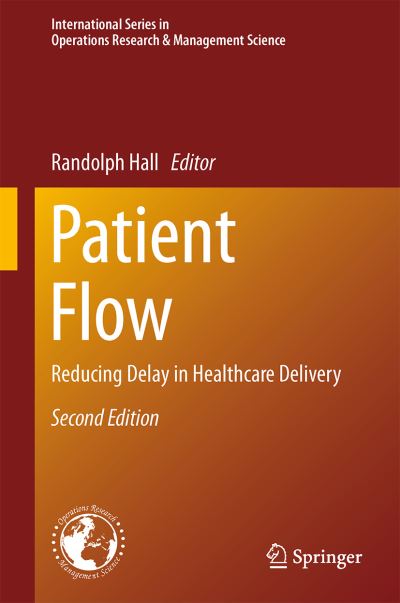
This book is dedicated to improving healthcare through reducing delays experienced by patients. With an interdisciplinary approach, this new edition, divided into five sections, begins by examining healthcare as an integrated system. Chapter 1 provides a hierarchical model of healthcare, rising from departments, to centers, regions and the "macro system." A new chapter demonstrates how to use simulation to assess the interaction of system components to achieve performance goals, and Chapter 3 provides hands-on methods for developing process models to identify and remove bottlenecks, and for developing facility plans.
Section 2 addresses crowding and the consequences of delay. Two new chapters (4 and 5) focus on delays in emergency departments, and Chapter 6 then examines medical outcomes that result from waits for surgeries. Section 3 concentrates on management of demand. Chapter 7 presents breakthrough strategies that use real-time monitoring systems for continuous improvement.
Chapter 8 looks at the patient appointment system, particularly through the approach of advanced access. Chapter 9 concentrates on managing waiting lists for surgeries, and Chapter 10 examines triage outside of emergency departments, with a focus on allied health programs
Section 4 offers analytical tools and models to support analysis of patient flows. Chapter 11 offers techniques for scheduling staff to match patterns in patient demand. Chapter 12 surveys the literature on simulation modeling, which is widely used for both healthcare design and process improvement.
Chapter 13 is new and demonstrates the use of process mapping to represent a complex regional trauma system. Chapter 14 provides methods for forecasting demand for healthcare on a region-wide basis. Chapter 15 presents queueing theory as a method for modeling waits in healthcare, and Chapter 16 focuses on rapid delivery of medication in the event of a catastrophic event.
Section 5 focuses onachieving change. Chapter 17 provides a diagnostic for assessing the state of a hospital and using the state assessment to select improvement strategies. Chapter 18 demonstrates the importance of optimizing care as patients transition from one care setting to the next. Chapter 19 is new and shows how to implement programs that improve patient satisfaction while also improving flow.
Chapter 20 illustrates how to evaluate the overall portfolio of patient diagnostic groups to guide system changes, and Chapter 21 provides project management tools to guide the execution of patient flow projects.
| ISBN: | 9781461495116 |
| Publication date: | 11th December 2013 |
| Author: | Randolph W Hall |
| Publisher: | Springer an imprint of Springer US |
| Format: | Hardback |
| Pagination: | 553 pages |
| Series: | International Series in Operations Research & Management Science |
| Genres: |
Operational research Medical administration and management Management decision making |
This book is dedicated to improving healthcare through reducing delays experienced by patients. With an interdisciplinary approach, this new edition, divided into five sections, begins by examining healthcare as an integrated system.
Patient Flow features in the following genres: Operational research, Medical administration and management, Management decision making
Hardback, Paperback. Not Available.
Patient Flow was written by Randolph W Hall and published by Springer an imprint of Springer US
Patient Flow has 553 pages
Yes it is part of International Series in Operations Research & Management Science series