

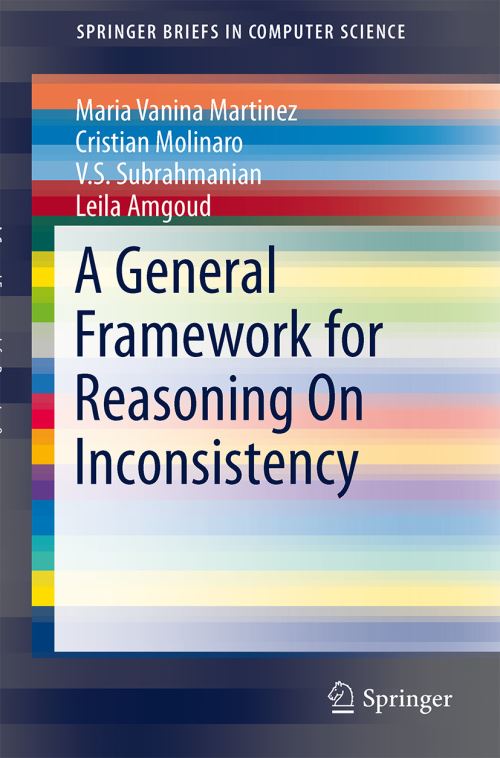
This SpringerBrief proposes a general framework for reasoning about inconsistency in a wide variety of logics, including inconsistency resolution methods that have not yet been studied. The proposed framework allows users to specify preferences on how to resolve inconsistency when there are multiple ways to do so. This empowers users to resolve inconsistency in data leveraging both their detailed knowledge of the data as well as their application needs.
The brief shows that the framework is well-suited to handle inconsistency in several logics, and provides algorithms to compute preferred options. Finally, the brief shows that the framework not only captures several existing works, but also supports reasoning about inconsistency in several logics for which no such methods exist today.
| ISBN: | 9781461467496 |
| Publication date: | 20th March 2013 |
| Author: | Maria Vanina Martinez |
| Publisher: | Springer an imprint of Springer New York |
| Format: | Paperback |
| Pagination: | 45 pages |
| Series: | SpringerBriefs in Computer Science |
| Genres: |
Artificial intelligence Expert systems / knowledge-based systems Data mining Mathematical theory of computation Databases |
This SpringerBrief proposes a general framework for reasoning about inconsistency in a wide variety of logics, including inconsistency resolution methods that have not yet been studied. The proposed framework allows users to specify preferences on how to resolve inconsistency when there are multiple ways to do so. This empowers users to resolve inconsistency in data leveraging both their detailed knowledge of the data as well as their application needs.
A General Framework for Reasoning on Inconsistency features in the following genres: Artificial intelligence, Expert systems / knowledge-based systems, Data mining, Mathematical theory of computation, Databases
Paperback. Not Available.
A General Framework for Reasoning on Inconsistency was written by Maria Vanina Martinez and published by Springer an imprint of Springer New York
A General Framework for Reasoning on Inconsistency has 45 pages
Yes it is part of SpringerBriefs in Computer Science series