

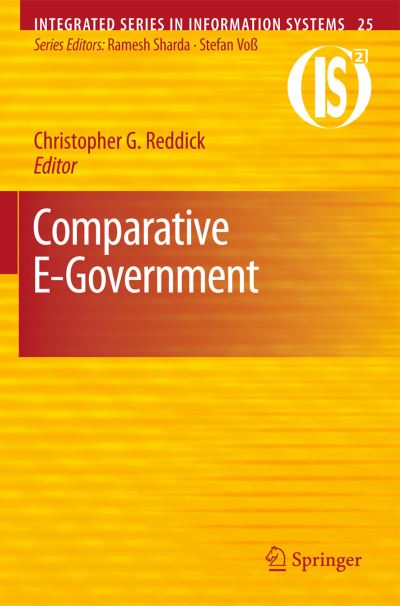
Comparative E-Government examines the impact of information and communication technology (ICT) on governments throughout the world. It focuses on the adoption of e-government both by comparing different countries, and by focusing on individual countries and the success and challenges that they have faced. With 32 chapters from leading e-government scholars and practitioners from around the world, there is representation of developing and developed countries and their different stages of e-government adoption.
Part I compares the adoption of e-government in two or more countries. The purpose of these chapters is to discern the development of e-government by comparing different counties and their individual experiences. Part II provides a more in-depth focus on case studies of e-government adoption in select countries.
Part III, the last part of the book, examines emerging innovations and technologies in the adoption of e-government in different countries. Some of the emerging technologies are the new social media movement, the development of e-participation, interoperability, and geographic information systems (GIS).
| ISBN: | 9781461426615 |
| Publication date: | 5th November 2012 |
| Author: | Christopher G Reddick |
| Publisher: | Springer an imprint of Springer New York |
| Format: | Paperback |
| Pagination: | 682 pages |
| Series: | Integrated Series in Information Systems |
| Genres: |
Network hardware |
Comparative E-Government examines the impact of information and communication technology (ICT) on governments throughout the world. It focuses on the adoption of e-government both by comparing different countries, and by focusing on individual countries and the success and challenges that they have faced.
Comparative E-Government features in the following genres: Network hardware
Paperback, Hardback. Not Available.
Comparative E-Government was written by Christopher G Reddick and published by Springer an imprint of Springer New York
Comparative E-Government has 682 pages
Yes it is part of Integrated Series in Information Systems series