

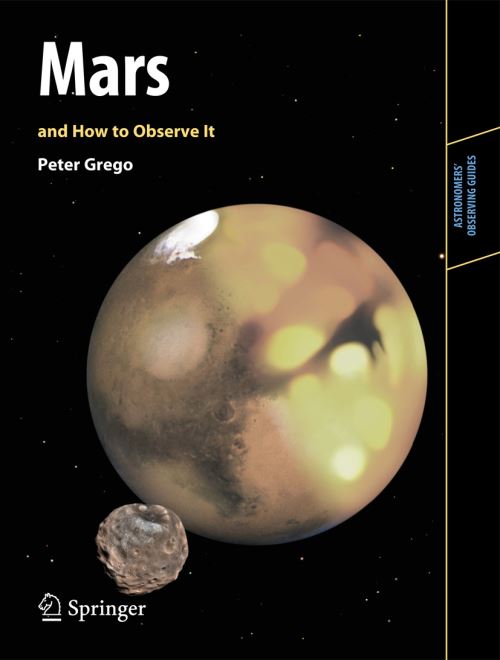
Mars, popularly known as the Red Planet because of its distinct color, is visible with the naked eye and is one of very few planets in the Solar System in which it is possible to see weather phenomena and surface features and thus is a favorite for amateur and practical astronomers. Commercially made telescopes can reveal its dusty surface markings, brilliant polar ice caps, and atmospheric phenomena. Many of Mars's features appear to change shape and intensity with the seasons: its polar caps grow and shrink cyclically, clouds billow above the Martian surface, and sometimes great dust storms obscure vast sections of the planet.
The first part of Mars and How to Observe It sets out our current knowledge of Mars as a planet - its orbit, physical characteristics, evolution over time, and current geology. A planet-wide tour of Mars's topography is featured, along with clearly labeled maps and close-up images of a variety of features.
The second part of the book explains how amateur and practical astronomers can observe Mars successfully. Many aspects are considered in depth, including preparing to observe, calculating phase and tilt, and making observational sketches and drawings. There are also plenty of details about how best to make high-resolution CCD images.
Since Mars changes in its apparent size in the sky according to its position in relation to Earth, it is best observed during its closest approaches. Future apparitions (appearances of the Red Planet) are therefore featured.
| ISBN: | 9781461423010 |
| Publication date: | 7th June 2012 |
| Author: | Peter Grego |
| Publisher: | Springer an imprint of Springer New York |
| Format: | Paperback |
| Pagination: | 238 pages |
| Series: | Astronomers' Observing Guides |
| Genres: |
Astronomical observation: observatories, equipment and methods Solar system: the Sun and planets Astronomy, space and time |
Mars, popularly known as the Red Planet because of its distinct color, is visible with the naked eye and is one of very few planets in the Solar System in which it is possible to see weather phenomena and surface features and thus is a favorite for amateur and practical astronomers. Commercially made telescopes can reveal its dusty surface markings, brilliant polar ice caps, and atmospheric phenomena.
Mars and How to Observe It features in the following genres: Astronomical observation: observatories, equipment and methods, Solar system: the Sun and planets, Astronomy, space and time
Paperback, Ebook. Not Available.
Mars and How to Observe It was written by Peter Grego and published by Springer an imprint of Springer New York
Mars and How to Observe It has 238 pages
Yes it is part of Astronomers' Observing Guides series