

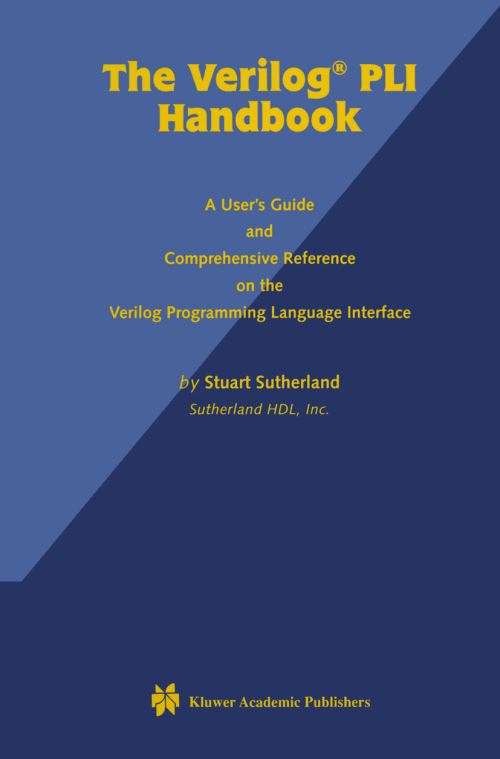
The Verilog Programming Language Interface, commonly called the Verilog PU, is one of the more powerful features of Verilog. The PU provides a means for both hardware designers and software engineers to interface their own programs to commercial Verilog simulators. Through this interface, a Verilog simulator can be customized to perform virtually any engineering task desired. Just a few of the common uses of the PU include interfacing Veri log simulations to C language models, adding custom graphical tools to a simulator, reading and writing proprietary file formats from within a simulation, performing test coverage analysis during simulation, and so forth. The applications possible with the Verilog PLI are endless.
Intended audience: this book is written for digital design engineers with a background in the Verilog Hardware Description Language and a fundamental knowledge of the C programming language. It is expected that thereader:| ISBN: | 9781461372790 |
| Publication date: | 5th November 2012 |
| Author: | Stuart Sutherland |
| Publisher: | Springer an imprint of Springer US |
| Format: | Paperback |
| Pagination: | 785 pages |
| Genres: |
Electronics: circuits and components Computer-aided design (CAD) Electrical engineering Computer hardware |
The Verilog Programming Language Interface, commonly called the Verilog PU, is one of the more powerful features of Verilog. The PU provides a means for both hardware designers and software engineers to interface their own programs to commercial Verilog simulators.
The Verilog PLI Handbook features in the following genres: Electronics: circuits and components, Computer-aided design (CAD), Electrical engineering, Computer hardware
Paperback. Not Available.
The Verilog PLI Handbook was written by Stuart Sutherland and published by Springer an imprint of Springer US
The Verilog PLI Handbook has 785 pages