

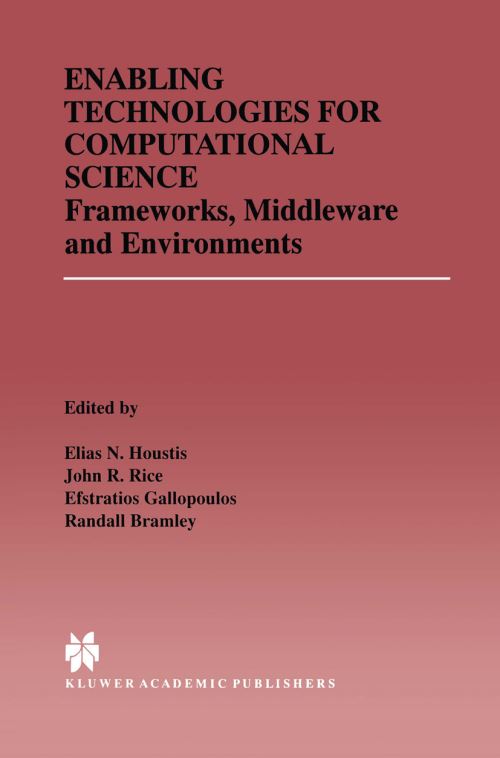
Enabling Technologies for Computational Science assesses future application computing needs, identifies research directions in problem-solving environments (PSEs), addresses multi-disciplinary environments operating on the Web, proposes methodologies and software architectures for building adaptive and human-centered PSEs, and describes the role of symbolic computing in scientific and engineering PSEs.
The book also includes an extensive bibliography of over 400 references.
Enabling Technologies for Computational Science illustrates the extremely broad and interdisciplinary nature of the creation and application of PSEs. Authors represent academia, government laboratories and industry, and come from eight distinct disciplines (chemical engineering, computer science, ecology, electrical engineering, mathematics, mechanical engineering, psychology and wood sciences).
This breadth and diversity extends into the computer science aspects of PSEs. These papers deal with topics such as artificial intelligence, computer-human interaction, control, data mining, graphics, language design and implementation, networking, numerical analysis, performance evaluation, and symbolic computing.
Enabling Technologies for Computational Science provides an assessment of the state of the art and a road map to the future in the area of problem-solving environments for scientific computing. This book is suitable as a reference for scientists from a variety of disciplines interested in using PSEs for their research.
| ISBN: | 9781461370499 |
| Publication date: | 5th November 2012 |
| Author: | Elias N Houstis, John R Rice, Efstratios Gallopoulos, Randall Bramley |
| Publisher: | Springer an imprint of Springer US |
| Format: | Paperback |
| Pagination: | 402 pages |
| Series: | The Springer International Series in Engineering and Computer Science |
| Genres: |
Mathematical theory of computation Numerical analysis Mathematical physics Network hardware Computer science |
Enabling Technologies for Computational Science assesses future application computing needs, identifies research directions in problem-solving environments (PSEs), addresses multi-disciplinary environments operating on the Web, proposes methodologies and software architectures for building adaptive and human-centered PSEs, and describes the role of symbolic computing in scientific and engineering PSEs. The book also includes an extensive bibliography of over 400 references.
Enabling Technologies for Computational Science features in the following genres: Mathematical theory of computation, Numerical analysis, Mathematical physics, Network hardware, Computer science
Paperback. Not Available.
Enabling Technologies for Computational Science was written by Elias N Houstis, John R Rice, Efstratios Gallopoulos, Randall Bramley and published by Springer an imprint of Springer US
Enabling Technologies for Computational Science has 402 pages
Yes it is part of The Springer International Series in Engineering and Computer Science series