

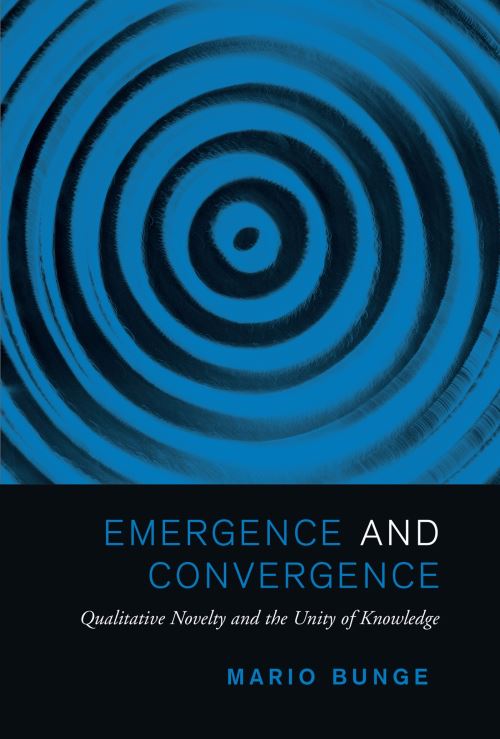
Two problems continually arise in the sciences and humanities, according to Mario Bunge: parts and wholes and the origin of novelty. In Emergence and Convergence, he works to address these problems, as well as that of systems and their emergent properties, as exemplified by the synthesis of molecules, the creation of ideas, and social inventions.
Along the way, Bunge examines further topical problems, such as the search for the mechanisms underlying observable facts, the limitations of both individualism and holism, the reach of reduction, the abuses of Darwinism, the rational choice-hermeneutics feud, the modularity of the brain vs. the unity of the mind, the cluster of concepts around 'maybe,' the uselessness of many-worlds metaphysics and semantics, the hazards posed by Bayesianism, the nature of partial truth, the obstacles to correct medical diagnosis, and the formal conditions for the emergence of a cross-discipline.
Bunge is not interested in idle fantasies, but about many of the problems that occur in any discipline that studies reality or ways to control it. His work is about the merger of initially independent lines of inquiry, such as developmental evolutionary biology, cognitive neuroscience, and socio-economics. Bunge proposes a clear definition of the concept of emergence to replace that of supervenience and clarifies the notions of system, real possibility, inverse problem, interdiscipline, and partial truth that occur in all fields.
| ISBN: | 9781442628212 |
| Publication date: | 9th July 2014 |
| Author: | Mario Bunge |
| Publisher: | University of Toronto Press |
| Format: | Paperback |
| Pagination: | 344 pages |
| Series: | Toronto Studies in Philosophy |
| Genres: |
Philosophy |
Two problems continually arise in the sciences and humanities, according to Mario Bunge: parts and wholes and the origin of novelty. In Emergence and Convergence, he works to address these problems, as well as that of systems and their emergent properties, as exemplified by the synthesis of molecules, the creation of ideas, and social inventions.
Emergence and Convergence features in the following genres: Philosophy
Ebook, Paperback. Not Available.
Emergence and Convergence was written by Mario Bunge and published by University of Toronto Press
Emergence and Convergence has 344 pages
Yes it is part of Toronto Studies in Philosophy series