

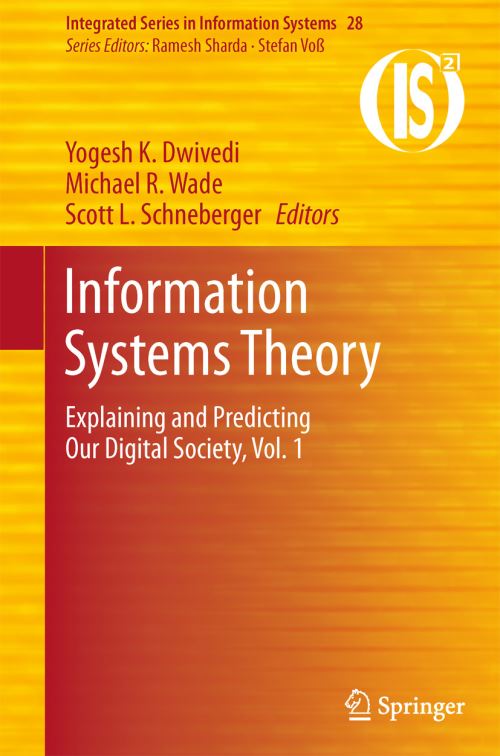
The overall mission of this book is to provide a comprehensive understanding and coverage of the various theories and models used in IS research. Specifically, it aims to focus on the following key objectives:
This book contributes to our understanding of a number of theories and models. The theoretical contribution of this book is that it analyzes and synthesizes the relevant literature in order to enhance knowledge of IS theories and models from various perspectives. To cater to the information needs of a diverse spectrum of readers, this book is structured into two volumes, with each volume further broken down into two sections.
The first section of Volume 1 presents detailed descriptions of a set of theories centered around the IS lifecycle, including the Success Model, Technology Acceptance Model, User Resistance Theories, and four others. The second section of Volume 1 contains strategic and economic theories, including a Resource-Based View, Theory of Slack Resources, PortfolioTheory, Discrepancy Theory Models, and eleven others.
The first section of Volume 2 concerns socio-psychological theories. These include Personal Construct Theory, Psychological Ownership, Transactive Memory, Language-Action Approach, and nine others. The second section of Volume 2 deals with methodological theories, including Critical Realism, Grounded Theory, Narrative Inquiry, Work System Method, and four others.
Together, these theories provide a rich tapestry of knowledge around the use of theory in IS research. Since most of these theories are from contributing disciplines, they provide a window into the world of external thought leadership.
| ISBN: | 9781441961075 |
| Publication date: | 20th September 2011 |
| Author: | Yogesh Kumar Dwivedi, Michael R Wade, Scott L Schneberger |
| Publisher: | Springer an imprint of Springer New York |
| Format: | Hardback |
| Pagination: | 502 pages |
| Series: | Integrated Series in Information Systems |
| Genres: |
Business mathematics and systems Network hardware Applied computing Business applications |
The overall mission of this book is to provide a comprehensive understanding and coverage of the various theories and models used in IS research. Specifically, it aims to focus on the following key objectives: To describe the various theories and models applicable to studying IS/IT management issues.
Information Systems Theory features in the following genres: Business mathematics and systems, Network hardware, Applied computing, Business applications
Hardback. Not Available.
Information Systems Theory was written by Yogesh Kumar Dwivedi, Michael R Wade, Scott L Schneberger and published by Springer an imprint of Springer New York
Information Systems Theory has 502 pages
Yes it is part of Integrated Series in Information Systems series