

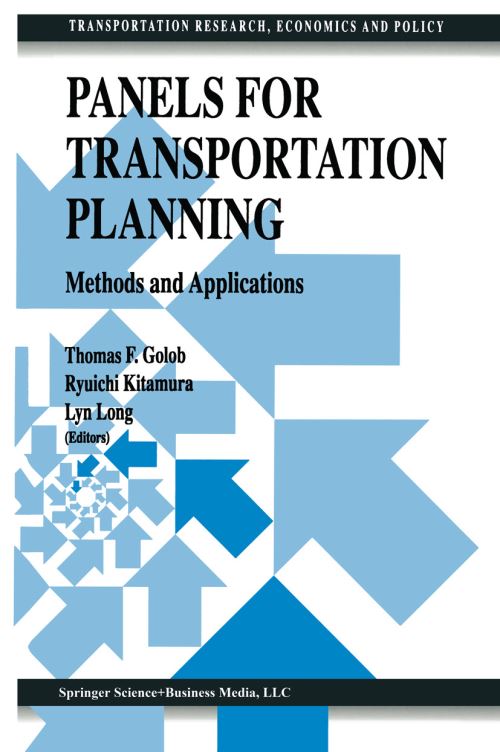
Panels for Transportation Planning argues that panels - repeated measurements on the same sets of households or individuals over time - can more effectively capture dynamic changes in travel behavior, and the factors which underlie these changes, than can conventional cross-sectional surveys. Because panels can collect information on household attributes, attitudes and perceptions, residential and employment choices, travel behavior and other variables - and then can collect information on changes in these variables over time - they help us to understand how and why people choose to travel as they do, and how and why these choices are likely to evolve in the future.
This book is designed for a wide audience: survey researchers who seek information on methodological advancements and applications; transportation planners who want an improved understanding of dynamic changes in travel behavior; and instructors of graduate courses in urban and transportation planning, research methods, economics, sociology, and public policy.
Each chapter has been prepared to stand alone to illustrate a particular theme or application.
The book is divided into topical parts which address the most salient issues in the use of panels for transportation planning: panels as evaluation tools, regional planning applications, accounting for response bias, and modeling and forecasting issues.
These parts describe panel applications in the US, Australia, Great Britain, Japan, and the Netherlands. Each chapter is supplemented by extensive references; more than 400 studies, reflecting the work of more than 700 authors, are cited in the text.
| ISBN: | 9781441951847 |
| Publication date: | 3rd December 2010 |
| Author: | Thomas F Golob, Ryuichi Kitamura, Lyn Long |
| Publisher: | Springer an imprint of Springer US |
| Format: | Paperback |
| Pagination: | 416 pages |
| Series: | Transportation Research, Economics and Policy |
| Genres: |
Political economy Regional / International studies Microeconomics |
Panels for Transportation Planning argues that panels - repeated measurements on the same sets of households or individuals over time - can more effectively capture dynamic changes in travel behavior, and the factors which underlie these changes, than can conventional cross-sectional surveys. Because panels can collect information on household attributes, attitudes and perceptions, residential and employment choices, travel behavior and other variables - and then can collect information on changes in these variables over time - they help us to understand how and why people choose to travel as they do, and how and why these choices are likely to evolve in the future.
Panels for Transportation Planning features in the following genres: Political economy, Regional / International studies, Microeconomics
Paperback, Hardback. Not Available.
Panels for Transportation Planning was written by Thomas F Golob, Ryuichi Kitamura, Lyn Long and published by Springer an imprint of Springer US
Panels for Transportation Planning has 416 pages
Yes it is part of Transportation Research, Economics and Policy series