

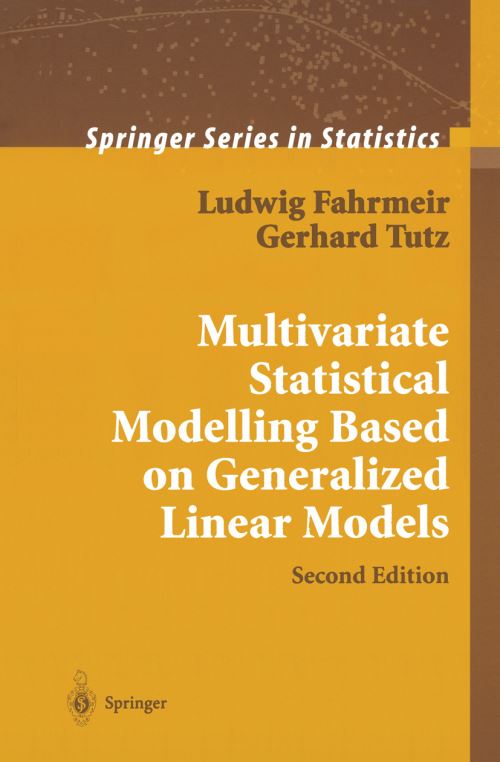
Since our first edition of this book, many developments in statistical mod- elling based on generalized linear models have been published, and our primary aim is to bring the book up to date. Naturally, the choice of these recent developments reflects our own teaching and research interests. The new organization parallels that of the first edition.
We try to motiv- ate and illustrate concepts with examples using real data, and most data sets are available on http:/ fwww. stat. uni-muenchen. de/welcome_e. html, with a link to data archive. We could not treat all recent developments in the main text, and in such cases we point to references at the end of each chapter. Many changes will be found in several sections, especially with those connected to Bayesian concepts.
For example, the treatment of marginal models in Chapter 3 is now current and state-of-the-art. The coverage of nonparametric and semiparametric generalized regression in Chapter 5 is completely rewritten with a shift of emphasis to linear bases, as well as new sections on local smoothing approaches and Bayesian inference. Chapter 6 now incorporates developments in parametric modelling of both time series and longitudinal data.
Additionally, random effect models in Chapter 7 now cover nonparametric maximum likelihood and a new section on fully Bayesian approaches. The modifications and extensions in Chapter 8 reflect the rapid development in state space and hidden Markov models.
| ISBN: | 9781441929006 |
| Publication date: | 1st December 2010 |
| Author: | L Fahrmeir, Gerhard Tutz |
| Publisher: | Springer an imprint of Springer New York |
| Format: | Paperback |
| Pagination: | 548 pages |
| Series: | Springer Series in Statistics |
| Genres: |
Probability and statistics Mathematical modelling Stochastics Maths for engineers Economics, Finance, Business and Management |
Since our first edition of this book, many developments in statistical mod- elling based on generalized linear models have been published, and our primary aim is to bring the book up to date. Naturally, the choice of these recent developments reflects our own teaching and research interests.
Multivariate Statistical Modelling Based on Generalized Linear Models features in the following genres: Probability and statistics, Mathematical modelling, Stochastics, Maths for engineers, Economics, Finance, Business and Management
Paperback, Hardback. Not Available.
Multivariate Statistical Modelling Based on Generalized Linear Models was written by L Fahrmeir, Gerhard Tutz and published by Springer an imprint of Springer New York
Multivariate Statistical Modelling Based on Generalized Linear Models has 548 pages
Yes it is part of Springer Series in Statistics series