

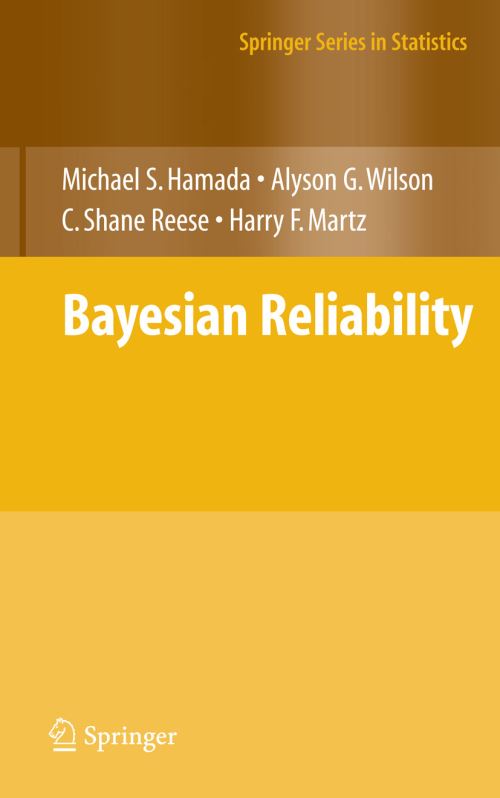
Bayesian Reliability presents modern methods and techniques for analyzing reliability data from a Bayesian perspective. The adoption and application of Bayesian methods in virtually all branches of science and engineering have significantly increased over the past few decades. This increase is largely due to advances in simulation-based computational tools for implementing Bayesian methods.
The authors extensively use such tools throughout this book, focusing on assessing the reliability of components and systems with particular attention to hierarchical models and models incorporating explanatory variables. Such models include failure time regression models, accelerated testing models, and degradation models.
The authors pay special attention to Bayesian goodness-of-fit testing, model validation, reliability test design, and assurance test planning. Throughout the book, the authors use Markov chain Monte Carlo (MCMC) algorithms for implementing Bayesian analyses -- algorithms that make the Bayesian approach to reliability computationally feasible and conceptually straightforward.
This book is primarily a reference collection of modern Bayesian methods in reliability for use by reliability practitioners. There are more than 70 illustrative examples, most of which utilize real-world data. This book can also be used as a textbook for a course in reliability and contains more than 160 exercises.
Noteworthy highlights of the book include Bayesian approaches for the following:
| ISBN: | 9781441926739 |
| Publication date: | 10th November 2010 |
| Author: | Michael Hamada |
| Publisher: | Springer an imprint of Springer New York |
| Format: | Paperback |
| Pagination: | 437 pages |
| Series: | Springer Series in Statistics |
| Genres: |
Probability and statistics Stochastics Security and fire alarm systems |
Bayesian Reliability presents modern methods and techniques for analyzing reliability data from a Bayesian perspective. The adoption and application of Bayesian methods in virtually all branches of science and engineering have significantly increased over the past few decades.
Bayesian Reliability features in the following genres: Probability and statistics, Stochastics, Security and fire alarm systems
Paperback, Hardback. Not Available.
Bayesian Reliability was written by Michael Hamada and published by Springer an imprint of Springer New York
Bayesian Reliability has 437 pages
Yes it is part of Springer Series in Statistics series