

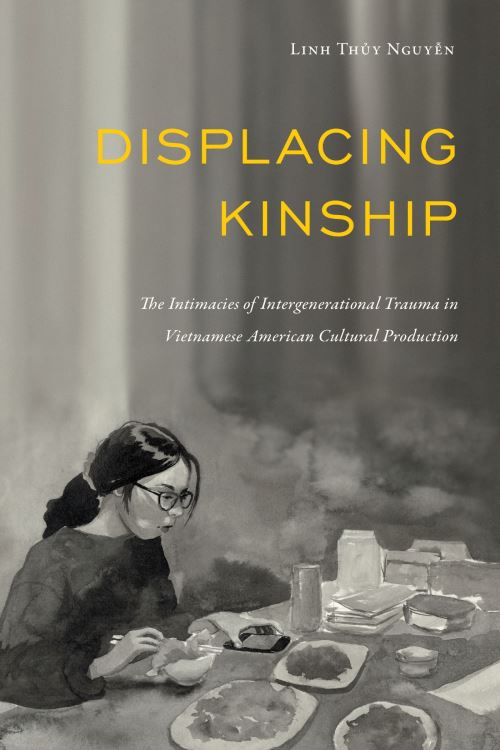
Nearly fifty years after the end of the war in Vietnam, American children of Vietnamese refugees continue to process the meanings of the war and its consequences through creative work. Displacing Kinship examines how Vietnamese American cultural productions register lived experiences of racism in their depictions of family life and marginalization.
Second-generation texts illustrate how the children of refugees from Vietnam are haunted by trauma and a violent, ever-present, but mostly unarticulated past. Linh Th?y Nguy?n's analysis reveals that present experiences of economic insecurity and racism also shape these narratives of familial loss.
Developing a theory of intergenerational trauma, Nguy?n rethinks how U.S. imperialism, the discourse of communism, and assimilation impacted families across generations. Through ethnic studies and feminist and queer-of-color critique, Displacing Kinship offers a critical approach for reading family tensions and interpersonal conflict as affective investments informed by the material, structural conditions of white supremacy and racial capitalism.
| ISBN: | 9781439924709 |
| Publication date: | 15th March 2024 |
| Author: | Linh Thuy Nguyên |
| Publisher: | Temple University Press |
| Format: | Paperback |
| Pagination: | 216 pages |
| Series: | Asian American History and Culture |
| Genres: |
Literature: history and criticism Ethnic studies Social and cultural history |
Nearly fifty years after the end of the war in Vietnam, American children of Vietnamese refugees continue to process the meanings of the war and its consequences through creative work. Displacing Kinship examines how Vietnamese American cultural productions register lived experiences of racism in their depictions of family life and marginalization.
Displacing Kinship features in the following genres: Literature: history and criticism, Ethnic studies, Social and cultural history
Paperback. Not Available.
Displacing Kinship was written by Linh Thuy Nguyên and published by Temple University Press
Displacing Kinship has 216 pages
Yes it is part of Asian American History and Culture series