

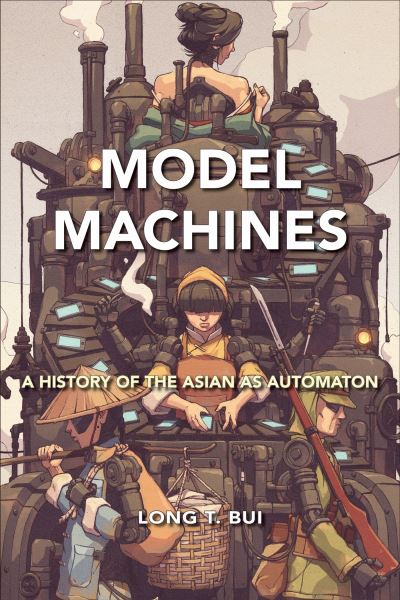
In the contemporary Western imagination, Asian people are frequently described as automatons, which disavows their humanity. In Model Machines, Long Bui investigates what he calls Asian roboticism or the ways Asians embody the machine and are given robotic characteristics.
Bui offers the first historical overview of the overlapping racialization of Asians and Asian Americans through their conflation with the robot-machine nexus. He puts forth the concept of the "model machine myth," which holds specific queries about personhood, citizenship, labor, and rights in the transnational making of Asian/America.
The case studies in Model Machines chart the representation of Chinese laborers, Japanese soldiers, Asian sex workers, and other examples to show how Asians are reimagined to be model machines as a product of globalization, racism, and colonialism. Moreover, it offers examples of how artists and everyday people resisted that stereotype to consider different ways of being human. Starting from the early nineteenth century, the book ends in the present with the new millennium, where the resurgence of China presages the "rise of the machines" and all the doomsday scenarios this might spell for global humanity at large.
| ISBN: | 9781439922330 |
| Publication date: | 10th June 2022 |
| Author: | Long T Bui |
| Publisher: | Temple University Press |
| Format: | Hardback |
| Pagination: | 305 pages |
| Series: | Asian American History and Culture |
| Genres: |
Ethnic studies Social and cultural anthropology Social and cultural history |
In the contemporary Western imagination, Asian people are frequently described as automatons, which disavows their humanity. In Model Machines, Long Bui investigates what he calls Asian roboticism or the ways Asians embody the machine and are given robotic characteristics. Bui offers the first historical overview of the overlapping racialization of Asians and Asian Americans through their conflation with the robot-machine nexus.
Model Machines features in the following genres: Ethnic studies, Social and cultural anthropology, Social and cultural history
Hardback, Paperback. Not Available.
Model Machines was written by Long T Bui and published by Temple University Press
Model Machines has 305 pages
Yes it is part of Asian American History and Culture series