

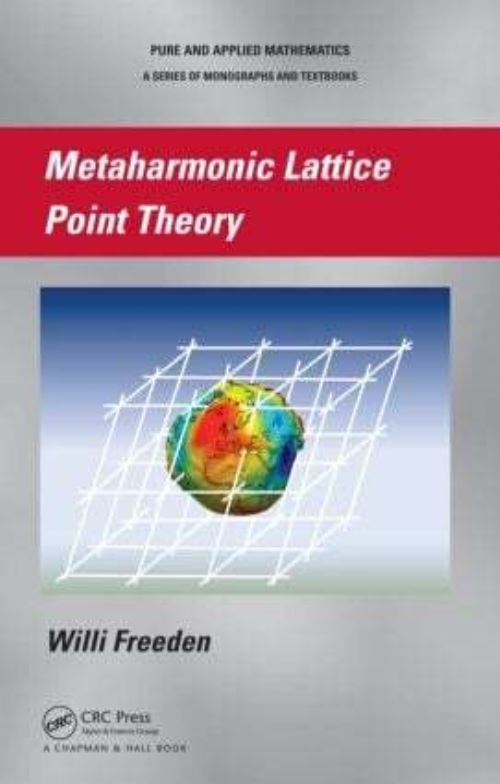
Metaharmonic Lattice Point Theory covers interrelated methods and tools of spherically oriented geomathematics and periodically reflected analytic number theory. The book establishes multi-dimensional Euler and Poisson summation formulas corresponding to elliptic operators for the adaptive determination and calculation of formulas and identities of weighted lattice point numbers, in particular the non-uniform distribution of lattice points.
The author explains how to obtain multi-dimensional generalizations of the Euler summation formula by interpreting classical Bernoulli polynomials as Green's functions and linking them to Zeta and Theta functions. To generate multi-dimensional Euler summation formulas on arbitrary lattices, the Helmholtz wave equation must be converted into an associated integral equation using Green's functions as bridging tools. After doing this, the weighted sums of functional values for a prescribed system of lattice points can be compared with the corresponding integral over the function.
Exploring special function systems of Laplace and Helmholtz equations, this book focuses on the analytic theory of numbers in Euclidean spaces based on methods and procedures of mathematical physics. It shows how these fundamental techniques are used in geomathematical research areas, including gravitation, magnetics, and geothermal.
| ISBN: | 9781439861844 |
| Publication date: | 7th June 2011 |
| Author: | W Freeden |
| Publisher: | Chapman & Hall/CRC an imprint of CRC Press |
| Format: | Hardback |
| Pagination: | 447 pages |
| Series: | Monographs and Textbooks in Pure and Applied Mathematics |
| Genres: |
Agricultural science Geophysics Applied mathematics Earth sciences Environmental science, engineering and technology |
Metaharmonic Lattice Point Theory covers interrelated methods and tools of spherically oriented geomathematics and periodically reflected analytic number theory. The book establishes multi-dimensional Euler and Poisson summation formulas corresponding to elliptic operators for the adaptive determination and calculation of formulas and identities of weighted lattice point numbers, in particular the non-uniform distribution of lattice points.The author explains how to obtain multi-dimensional generalizations of the Euler summation formula by interpreting classical Bernoulli polynomials as Green's functions and linking them to Zeta and Theta functions.
Metaharmonic Lattice Point Theory features in the following genres: Agricultural science, Geophysics, Applied mathematics, Earth sciences, Environmental science, engineering and technology
Hardback. £189.00, down from the £210.00 cover price. Not Available.
Metaharmonic Lattice Point Theory was written by W Freeden and published by Chapman & Hall/CRC an imprint of CRC Press
Metaharmonic Lattice Point Theory has 447 pages
Yes it is part of Monographs and Textbooks in Pure and Applied Mathematics series
£189.00, reduced from £210.00. Not Available.