

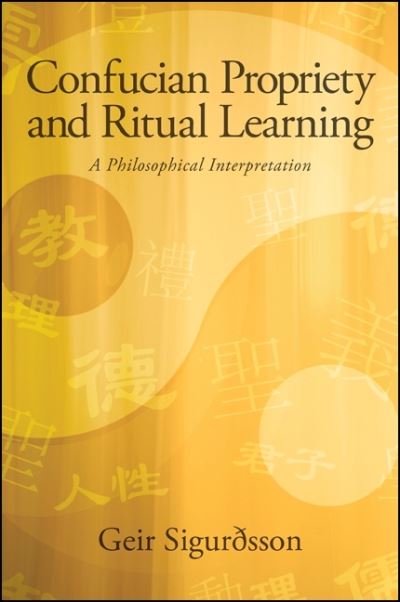
A reconsideration of the Confucian concept li (ritual or ritual propriety), one that references Western philosophers as well as the Chinese context.
Honorable Mention, 2018 Outstanding Book Award presented by the Society of Professors of Education
Geir Sigurðsson offers a reconsideration of li, often translated as "ritual" or "ritual propriety," one of the most controversial concepts in Confucian philosophy. Strong associations with the Zhou period during which Confucius lived have put this concept at odds with modernity's emphasis on progressive rationality and liberation from the yoke of tradition. Sigurðsson notes how the Confucian perspective on learning provides a more balanced understanding of li. He goes on to discuss the limitations of the critique of tradition and of rationality's claim to authority, referencing several Western sources, notably Hans-Georg Gadamer, John Dewey, and Pierre Bourdieu. An exposition of the ancient Chinese worldview of time and continuous change further points to the inevitability of li's adaptable and flexible nature. Sigurðsson argues that Confucius and his immediate followers did not endorse a program of returning to the Zhou tradition, but rather of reviving the spirit of Zhou culture, involving active and personalized participation in tradition's sustention and evolution.
| ISBN: | 9781438454405 |
| Publication date: | 2nd January 2016 |
| Author: | Geir Sigurðsson |
| Publisher: | SUNY Press an imprint of State University of New York Press |
| Format: | Paperback |
| Pagination: | 177 pages |
| Series: | SUNY Series in Chinese Philosophy and Culture |
| Genres: |
Confucianism East Asian and Indian philosophy |
A reconsideration of the Confucian concept li (ritual or ritual propriety), one that references Western philosophers as well as the Chinese context.
Honorable Mention, 2018 Outstanding Book Award presented by the Society of Professors of Education
Geir Sigurðsson offers a reconsideration of li, often translated as "ritual" or "ritual propriety," one of the most controversial concepts in Confucian philosophy. Strong associations with the Zhou period during which Confucius lived have put this concept at odds with modernity's emphasis on progressive rationality and liberation from the yoke of tradition. Sigurðsson notes how the Confucian perspective on learning provides a more balanced understanding of li. He goes on to discuss the limitations of the critique of tradition and of rationality's claim to authority, referencing several Western sources, notably Hans-Georg Gadamer, John Dewey, and Pierre Bourdieu. An exposition of the ancient Chinese worldview of time and continuous change further points to the inevitability of li's adaptable and flexible nature. Sigurðsson argues that Confucius and his immediate followers did not endorse a program of returning to the Zhou tradition, but rather of reviving the spirit of Zhou culture, involving active and personalized participation in tradition's sustention and evolution.
Confucian Propriety and Ritual Learning features in the following genres: Confucianism, East Asian and Indian philosophy
Confucian Propriety and Ritual Learning is available in Paperback
Confucian Propriety and Ritual Learning was written by Geir Sigurðsson and published by SUNY Press an imprint of State University of New York Press
Confucian Propriety and Ritual Learning has 177 pages
Yes it is part of SUNY Series in Chinese Philosophy and Culture series