

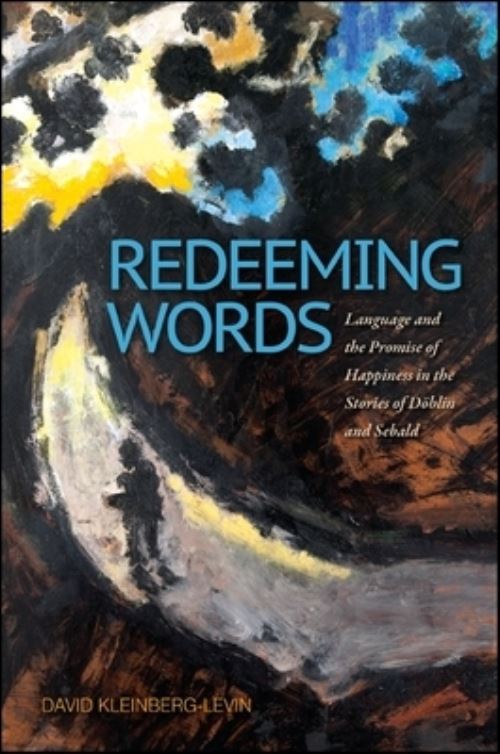
Probing study of how literature can redeem the revelatory, redemptive powers of language.
In this probing look at Alfred Döblin's 1929 novel Berlin Alexanderplatz and the stories of W. G. Sebald, Redeeming Words offers a philosophical meditation on the power of language in literature. David Kleinberg-Levin draws on the critical theory of Benjamin and Adorno; the idealism and romanticism of Kant, Hegel, Hölderlin, Novalis, and Schelling; and the nineteenth- and twentieth-century thought of Nietzsche, Heidegger, and Derrida.
He shows how Döblin and Sebald-writers with radically different styles working in different historical moments-have in common a struggle against forces of negativity and an aim to bring about in response a certain redemption of language. Kleinberg-Levin considers the fast-paced, staccato, and hard-cut sentences of Döblin and the ghostly, languorous, and melancholy prose fiction of Sebald to articulate how both writers use language in an attempt to recover and convey this utopian promise of happiness for life in a time of mourning.
| ISBN: | 9781438447803 |
| Publication date: | 2nd July 2014 |
| Author: | David Michael KleinbergLevin |
| Publisher: | SUNY Press an imprint of State University of New York Press |
| Format: | Paperback |
| Pagination: | 324 pages |
| Series: | SUNY Series, Intersections: Philosophy and Critical Theory |
| Genres: |
Literature: history and criticism Phenomenology and Existentialism Philosophy: aesthetics Philosophy |
Probing study of how literature can redeem the revelatory, redemptive powers of language.In this probing look at Alfred Döblin's 1929 novel Berlin Alexanderplatz and the stories of W. G.
Redeeming Words features in the following genres: Literature: history and criticism, Phenomenology and Existentialism, Philosophy: aesthetics, Philosophy
Paperback, Hardback, Ebook. Not Available.
Redeeming Words was written by David Michael KleinbergLevin and published by SUNY Press an imprint of State University of New York Press
Redeeming Words has 324 pages
Yes it is part of SUNY Series, Intersections: Philosophy and Critical Theory series