

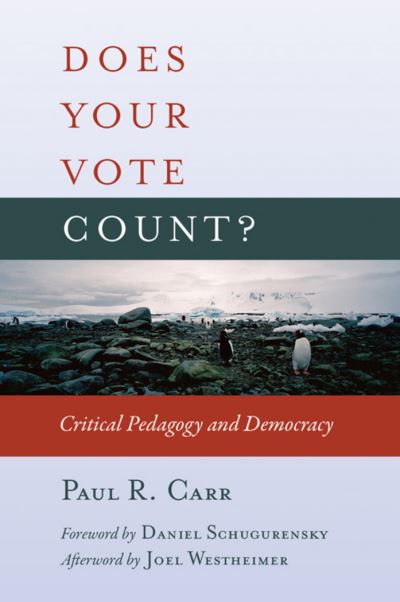
The public debate on democracy is often constrained within an alienating and disenfranchising narrative of opinion polls, campaign platforms, personalities and formal structures that generate legislation, all of which surreptitiously seems to trickle down to the classroom. Paul R. Carr asserts that democracy must be cultivated in a vigorous, conscientious, meaningful and critical way in and through education in order for it to have salience in society, especially within a neoliberal conjuncture that promotes limited space for epistemological interrogation of how we understand and are engaged in maintaining and/or transforming our societies. Building on the critical pedagogical work of Paulo Freire, Joe L. Kincheloe, and others, this book develops a framework for understanding how a thicker democratic education can be conceptualized and implemented in schools. The book aims to move the focus on democracy away from voting, and place it more properly on the importance of social justice and political literacy as a way of understanding what democracy is and, importantly, how to make it more relevant for all of society. The book concludes that another democracy is possible, as well as being desirable, and that education is the fundamental intersection in which it must be developed.
| ISBN: | 9781433108129 |
| Publication date: | 4th January 2011 |
| Author: | Paul R Carr |
| Publisher: | Peter Lang an imprint of Peter Lang Inc., International Academic Publishers |
| Format: | Hardback |
| Pagination: | 333 pages |
| Series: | Counterpoints: Studies in the Postmodern Theory of Education |
| Genres: |
Philosophy and theory of education Political science and theory Sociology |
The public debate on democracy is often constrained within an alienating and disenfranchising narrative of opinion polls, campaign platforms, personalities and formal structures that generate legislation, all of which surreptitiously seems to trickle down to the classroom. Paul R. Carr asserts that democracy must be cultivated in a vigorous, conscientious, meaningful and critical way in and through education in order for it to have salience in society, especially within a neoliberal conjuncture that promotes limited space for epistemological interrogation of how we understand and are engaged in maintaining and/or transforming our societies. Building on the critical pedagogical work of Paulo Freire, Joe L. Kincheloe, and others, this book develops a framework for understanding how a thicker democratic education can be conceptualized and implemented in schools. The book aims to move the focus on democracy away from voting, and place it more properly on the importance of social justice and political literacy as a way of understanding what democracy is and, importantly, how to make it more relevant for all of society. The book concludes that another democracy is possible, as well as being desirable, and that education is the fundamental intersection in which it must be developed.
Does Your Vote Count ? features in the following genres: Philosophy and theory of education, Political science and theory, Sociology
Does Your Vote Count ? is available in Hardback, Paperback
Does Your Vote Count ? was written by Paul R Carr and published by Peter Lang an imprint of Peter Lang Inc., International Academic Publishers
Does Your Vote Count ? has 333 pages
Yes it is part of Counterpoints: Studies in the Postmodern Theory of Education series