

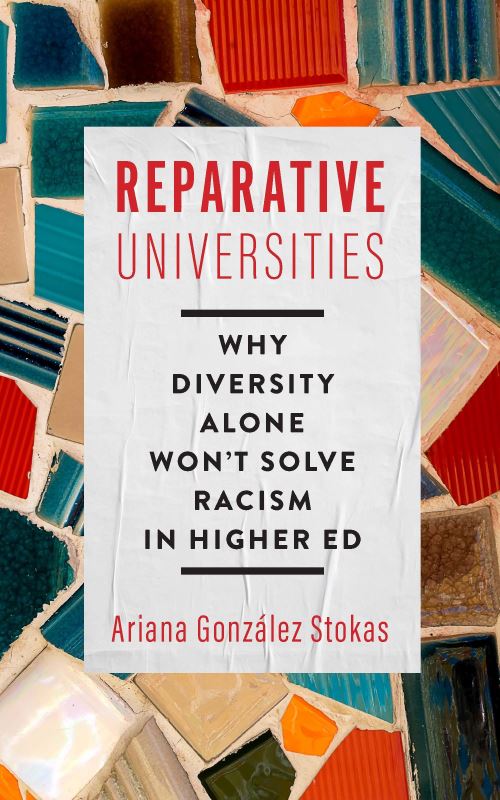
A timely investigation of why diversity alone is insufficient in higher education and how universities can use reparative actions to become anti-racist institutions.
As institutions increasingly reckon with histories entangled with slavery and Indigenous dispossession, diversity, equity, and inclusion (DEI) efforts occupy a central role in the strategy and resources of higher education. Yet reparation is rarely offered as a viable strategy for institutional transformation.
In Reparative Universities, Ariana González Stokas undertakes a critical and decolonial analysis of DEI work, linking contemporary practices of diversity to longer colonial histories. González Stokas argues that diversity is an insufficient concept for efforts concerned with anti-oppression, anti-racism, equity, and decolonization.
Given its historical ties to colonialism, can higher education foster reconciliation and healing?
Reparation is offered as a pathway toward untangling higher education from its colonial roots. González Stokas develops the term "epistemic reparation" to describe a mode of social-historical accountability that can already be seen at work in historical examples, as well as current events in the United States, South Africa, and Canada. Recent legal decisions by Georgetown University and the Princeton Theological seminary to enact economic recompense for buying and selling human beings are evidence of attempts to redress higher education's violent histories and the colonial structures they reproduce every day on college campuses.
Engaging with a broad range of theories from decolonial philosophy to organizational psychology, González Stokas offers a pathway-guided by reparative activities-for institutional workers frustrated by what often feels, as Sara Ahmed describes, like "banging one's head against a brick wall." Reparative Universities offers insight into why DEI efforts have been disconnected from past injustices and why unsettling diversity and engaging meaningful repair are critical for the future of higher education.
| ISBN: | 9781421445601 |
| Publication date: | 23rd May 2023 |
| Author: | Ariana González Stokas |
| Publisher: | Johns Hopkins University Press |
| Format: | Hardback |
| Pagination: | 288 pages |
| Series: | Critical University Studies |
| Genres: |
Higher education, tertiary education Sociology Philosophy and theory of education |
A timely investigation of why diversity alone is insufficient in higher education and how universities can use reparative actions to become anti-racist institutions.As institutions increasingly reckon with histories entangled with slavery and Indigenous dispossession, diversity, equity, and inclusion (DEI) efforts occupy a central role in the strategy and resources of higher education. Yet reparation is rarely offered as a viable strategy for institutional transformation.
Reparative Universities features in the following genres: Higher education, tertiary education, Sociology, Philosophy and theory of education
Hardback. £30.60, down from the £34.00 cover price. Not Available.
Reparative Universities was written by Ariana González Stokas and published by Johns Hopkins University Press
Reparative Universities has 288 pages
Yes it is part of Critical University Studies series
£30.60, reduced from £34.00. Not Available.