

Knowledge grows as ideas are tested against each other. Agreement is not resolved simply by naming concepts but in the dialectical process of thesis, antithesis, and synthesis. There are many echoes of these debates in The Evidence Book.
The contributors make claims for both practitioner wisdom and the voice of experience. Against this is posed the authority of experimental science and the randomized controlled trial.The contributors are concerned, in their own ways, with collecting, ranking, and analyzing evidence and using this to deliver evaluations. As an expert group, they are aware that the concept of evidence has been increasingly important in the last decade.
As with other concepts, it too often escapes precise definition. Despite this, the growing importance of evidence has been advocated with enthusiasm by supporters who see it as a way of increasing the effectiveness and quality of decisions and of professional life.The willingness to engage in evidence-based policy and the means to do so is heavily constrained by economic, political, and cultural climates. This book is a marvelously comprehensive and utterly unique treatise on evidence-based policy.
It is a wide-ranging contribution to the field of evaluation.
| ISBN: | 9781412810234 |
| Publication date: | 15th September 2009 |
| Author: | Olaf Rieper, Frans L Leeuw, Tom Ling |
| Publisher: | Routledge an imprint of Taylor & Francis |
| Format: | Hardback |
| Pagination: | 183 pages |
| Series: | Comparative Policy Evaluation |
| Genres: |
Research methods: general Social research and statistics Public administration |
Knowledge grows as ideas are tested against each other. Agreement is not resolved simply by naming concepts but in the dialectical process of thesis, antithesis, and synthesis.
The Evidence Book features in the following genres: Research methods: general, Social research and statistics, Public administration
Hardback. £37.79, down from the £41.99 cover price. Not Available.
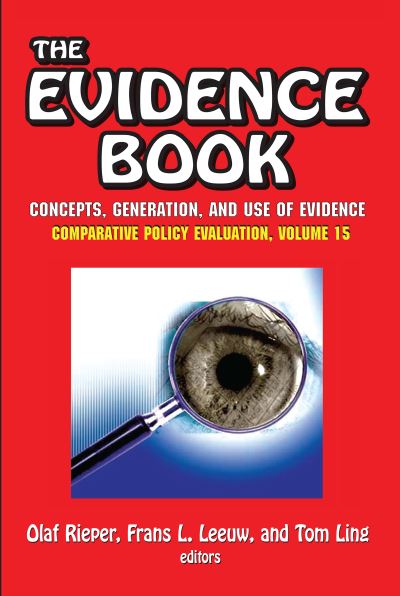
The Evidence Book was written by Olaf Rieper, Frans L Leeuw, Tom Ling and published by Routledge an imprint of Taylor & Francis
The Evidence Book has 183 pages
Yes it is part of Comparative Policy Evaluation series
£37.79, reduced from £41.99. Not Available.