

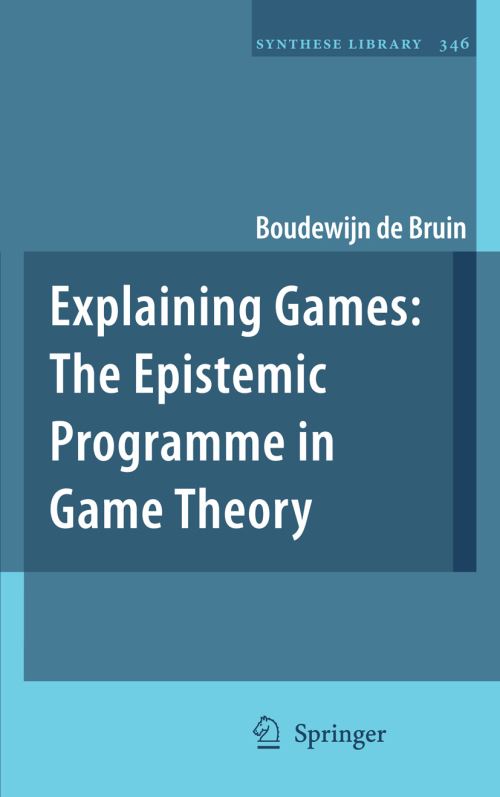
Does game theory - the mathematical theory of strategic interaction - provide genuine explanations of human behaviour? Can game theory be used in economic consultancy or other normative contexts? Explaining Games: The Epistemic Programme in Game Theory - the first monograph on the philosophy of game theory - is a bold attempt to combine insights from epistemic logic and the philosophy of science to investigate the applicability of game theory in such fields as economics, philosophy and strategic consultancy.
De Bruin proves new mathematical theorems about the beliefs, desires and rationality principles of individual human beings, and he explores in detail the logical form of game theory as it is used in explanatory and normative contexts. He argues that game theory reduces to rational choice theory if used as an explanatory device, and that game theory is nonsensical if used as a normative device. A provocative account of the history of game theory reveals that this is not bad news for all of game theory, though.
Two central research programmes in game theory tried to find the ultimate characterisation of strategic interaction between rational agents. Yet, while the Nash Equilibrium Refinement Programme has done badly thanks to such research habits as overmathematisation, model-tinkering and introversion, the Epistemic Programme, De Bruin argues, has been rather successful in achieving this aim.
| ISBN: | 9781402099052 |
| Publication date: | 18th September 2010 |
| Author: | Boudewijn Paul de Bruin |
| Publisher: | Springer an imprint of Springer Netherlands |
| Format: | Hardback |
| Pagination: | 175 pages |
| Series: | Synthese Library |
| Genres: |
Philosophy of science Philosophy: logic Game theory Applied mathematics Economic theory and philosophy Econometrics and economic statistics |
Does game theory - the mathematical theory of strategic interaction - provide genuine explanations of human behaviour? Can game theory be used in economic consultancy or other normative contexts?
Explaining Games features in the following genres: Philosophy of science, Philosophy: logic, Game theory, Applied mathematics, Economic theory and philosophy, Econometrics and economic statistics
Hardback. Not Available.
Explaining Games was written by Boudewijn Paul de Bruin and published by Springer an imprint of Springer Netherlands
Explaining Games has 175 pages
Yes it is part of Synthese Library series