

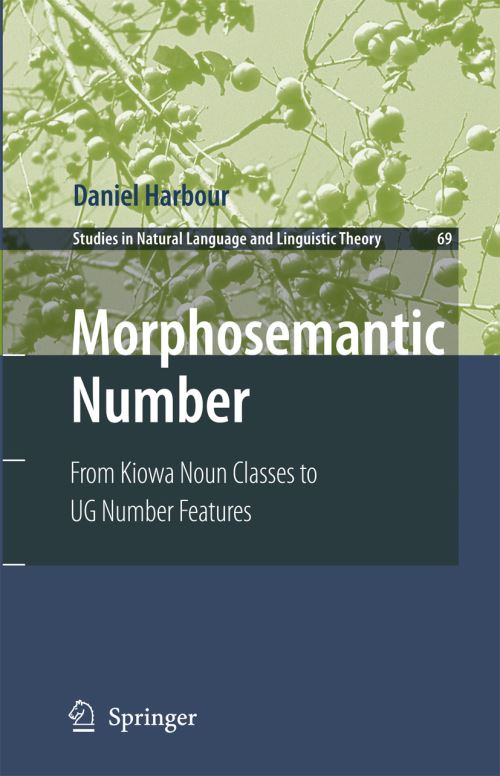
Number is a major research domain in semantics, syntax and morphology. However, no current theory of number is applicable to all three fields. In this work, the author argues that a unified theory is not only possible, but necessary for the study of Universal Grammar. Through insightful analysis of unfamiliar data, the author shows that one and the same feature set is implicated in semantic and morphological number phenomena alike, with syntax acting as the conduit between the two. At the heart of the study is an original treatment of Kiowa, a North American language with a remarkable constellation of characteristics, including semantically based noun classification and complex agreement morphology.
This volume presents: (1) the foundations of a unified morphosemantic theory of number; (2) insight into the flow of information from the lexicon, via syntax, into the morphology; (3) wide-ranging topics: nominal semantics, noun classes, DP syntax, agreement, suppletion, complex morphology.
| ISBN: | 9781402050398 |
| Publication date: | 20th March 2008 |
| Author: | Daniel Harbour |
| Publisher: | Springer an imprint of Springer Netherlands |
| Format: | Paperback |
| Pagination: | 216 pages |
| Series: | Studies in Natural Language and Linguistic Theory |
| Genres: |
Semiotics / semiology Phonetics, phonology Grammar, syntax and morphology Language: reference and general Linguistics |
Number is a major research domain in semantics, syntax and morphology. However, no current theory of number is applicable to all three fields.
Morphosemantic Number features in the following genres: Semiotics / semiology, Phonetics, phonology, Grammar, syntax and morphology, Language: reference and general, Linguistics
Paperback, Hardback, Ebook. Not Available.
Morphosemantic Number was written by Daniel Harbour and published by Springer an imprint of Springer Netherlands
Morphosemantic Number has 216 pages
Yes it is part of Studies in Natural Language and Linguistic Theory series