

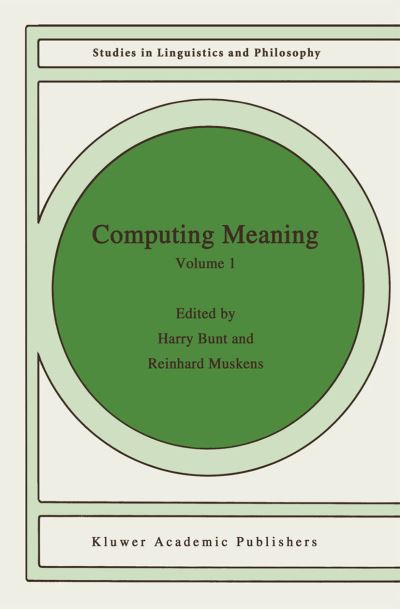
Computational semantics is concerned with computing the meanings of linguistic objects such as sentences, text fragments, and dialogue contributions. As such it is the interdisciplinary child of semantics, the study of meaning and its linguistic encoding, and computational linguistics, the discipline that is concerned with computations on linguistic objects.
From one parent computational semantics inherits concepts and techniques that have been developed under the banner of formal (or model-theoretic) semantics. This blend of logic and linguistics applies the methods of logic to the description of meaning. From the other parent the young discipline inherits methods and techniques for parsing sentences, for effective and efficient representation of syntactic structure and logical form, and for reasoning with semantic information.
Computational semantics integrates and further develops these methods, concepts and techniques.
This book is a collection of papers written by outstanding researchers in the newly emerging field of computational semantics. It is aimed at those linguists, computer scientists, and logicians who want to know more about the algorithmic realisation of meaning in natural language and about what is happening in this field of research. There is a general introduction by the editors.
| ISBN: | 9781402002908 |
| Publication date: | 30th November 2001 |
| Author: | H Bunt, Reinhard Muskens |
| Publisher: | Springer an imprint of Springer Netherlands |
| Format: | Paperback |
| Pagination: | 363 pages |
| Series: | Studies in Linguistics and Philosophy |
| Genres: |
Semiotics / semiology Philosophy: logic Natural language and machine translation Computational and corpus linguistics Artificial intelligence |
Computational semantics is concerned with computing the meanings of linguistic objects such as sentences, text fragments, and dialogue contributions. As such it is the interdisciplinary child of semantics, the study of meaning and its linguistic encoding, and computational linguistics, the discipline that is concerned with computations on linguistic objects.
Computing Meaning features in the following genres: Semiotics / semiology, Philosophy: logic, Natural language and machine translation, Computational and corpus linguistics, Artificial intelligence
Paperback. Not Available.
Computing Meaning was written by H Bunt, Reinhard Muskens and published by Springer an imprint of Springer Netherlands
Computing Meaning has 363 pages
Yes it is part of Studies in Linguistics and Philosophy series