

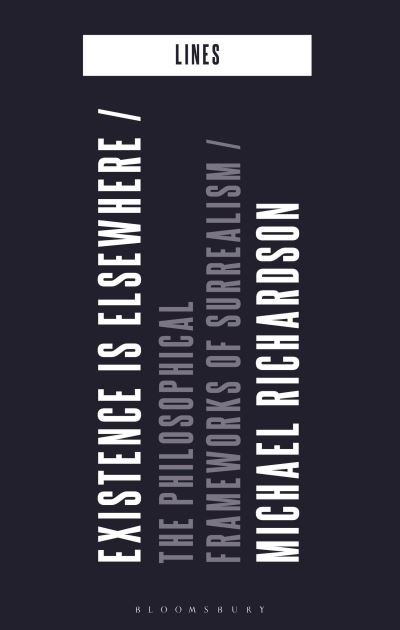
Existence is Elsewhere offers the first comprehensive account of surrealism as a movement sustained by philosophical ideas.Moving far beyond the familiar narrative linking surrealism to Freud, this study reveals a century-long engagement with thinkers as diverse as Hegel, Heraclitus, Parmenides, Schelling, Novalis, Nietzsche, and Fourier, as well as traditions outside the Western canon, from ancient Egypt to Chinese thought.Michael Richardson shows that surrealism was born of a network of encounters:
| ISBN: | 9781350531376 |
| Publication date: | 18th February 2027 |
| Author: | Michael Richardson |
| Publisher: | Bloomsbury Academic an imprint of Bloomsbury Publishing (UK) |
| Format: | Paperback |
| Pagination: | 224 pages |
| Series: | Lines |
| Genres: |
Social and political philosophy Critical theory Philosophy: aesthetics History of art Philosophy |
Existence is Elsewhere offers the first comprehensive account of surrealism as a movement sustained by philosophical ideas.Moving far beyond the familiar narrative linking surrealism to Freud, this study reveals a century-long engagement with thinkers as diverse as Hegel, Heraclitus, Parmenides, Schelling, Novalis, Nietzsche, and Fourier, as well as traditions outside the Western canon, from ancient Egypt to Chinese thought.Michael Richardson shows that surrealism was born of a network of encounters: collective experiments, shared crises after the First World War, and intense friendships that shaped its emergence between 1919 and 1924. Its philosophical orientation arose not from systematic study but from a "philosophical poetics" - a way of thinking through practice, intuition, and experiment.Across ten chapters, Richardson traces surrealism's relationship with dialectical thinking, analogy, myth, and the marvellous.
Existence Is Elsewhere features in the following genres: Social and political philosophy, Critical theory, Philosophy: aesthetics, History of art, Philosophy
Paperback, Hardback. £16.19, down from the £17.99 cover price. Not Available.
Existence Is Elsewhere was written by Michael Richardson and published by Bloomsbury Academic an imprint of Bloomsbury Publishing (UK)
Existence Is Elsewhere has 224 pages
Yes it is part of Lines series
£16.19, reduced from £17.99. Not Available.