

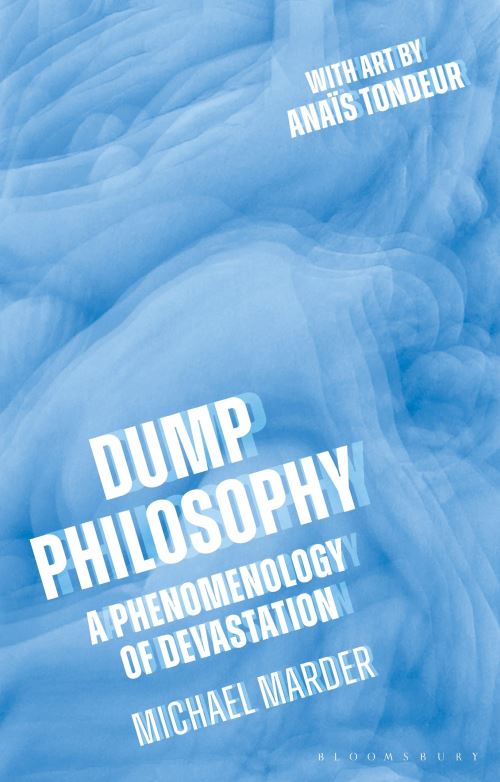
Ranging across philosophy, theology, ecology, psychology, and art, in Dump Philosophy Michael Marder argues that the earth, along with everything that lives and thinks on it, is at an advanced stage of being converted into a dump for industrial output and its by-products feeding consumerism and its excesses.
Every day, scientific studies, media reports, and first-hand accounts of the rapidly deteriorating state of the environment hit us with a growing and disconcerting force. Trends such as microplastics in water, airborne toxins, topsoil degradation, and dangerous levels of carbon dioxide have upset the delicate ecological balance that has until now been sustaining life on the planet.
Marder's original treatise paints a portrait of the Anthropocene as a global dump which wreaks havoc, causing disease and degrading our sensation, perception, and thinking, so that nuance is lost and ideas are reduced to soundbites in chains of free association. Describing the dump's fundamental characteristics and its effects on the body and the mind, he contemplates wider physiological, social, economic, and environmental metabolisms in the age of dumping, as well as the role of philosophy caught in its crosshairs. While surveying the devastation that is the reality of the twenty-first century, the book provides a frightening and yet intellectually spellbinding glimpse of the future.
| ISBN: | 9781350170599 |
| Publication date: | 10th December 2020 |
| Author: | Michael Marder |
| Illustrator: | Anais Tondeur |
| Publisher: | Bloomsbury Academic an imprint of Bloomsbury Publishing (UK) |
| Format: | Hardback |
| Pagination: | 200 pages |
| Genres: |
Philosophy Social and political philosophy Human geography Applied ecology Social impact of environmental issues |
Ranging across philosophy, theology, ecology, psychology, and art, in Dump Philosophy Michael Marder argues that the earth, along with everything that lives and thinks on it, is at an advanced stage of being converted into a dump for industrial output and its by-products feeding consumerism and its excesses.
Every day, scientific studies, media reports, and first-hand accounts of the rapidly deteriorating state of the environment hit us with a growing and disconcerting force. Trends such as microplastics in water, airborne toxins, topsoil degradation, and dangerous levels of carbon dioxide have upset the delicate ecological balance that has until now been sustaining life on the planet.
Marder's original treatise paints a portrait of the Anthropocene as a global dump which wreaks havoc, causing disease and degrading our sensation, perception, and thinking, so that nuance is lost and ideas are reduced to soundbites in chains of free association. Describing the dump's fundamental characteristics and its effects on the body and the mind, he contemplates wider physiological, social, economic, and environmental metabolisms in the age of dumping, as well as the role of philosophy caught in its crosshairs. While surveying the devastation that is the reality of the twenty-first century, the book provides a frightening and yet intellectually spellbinding glimpse of the future.
Dump Philosophy features in the following genres: Social and political philosophy, Social impact of environmental issues
Dump Philosophy is available in Paperback, Hardback
Dump Philosophy was written by Michael Marder and published by Bloomsbury Academic an imprint of Bloomsbury Publishing (UK)
Dump Philosophy has 200 pages
£67.50