

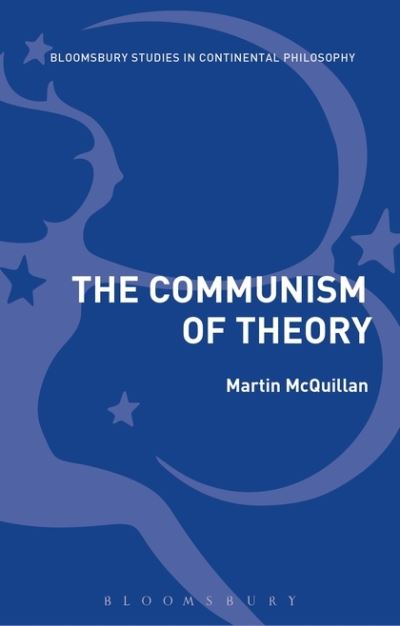
One of the notable trends within contemporary critical theory is the re-emergence of communism as a political proposition during a time of global financial crisis. This takes the form of explicit attempts to reformulate a communist project (Badiou), readings of a communist tradition (Zizek), and a reimagining of a communist inheritance (Rancière, Balibar). Within the field of critical theory these positions have tended to pass relatively unchallenged as other theoretical idioms (psychoanalysis, post-colonialism, feminism, post-structuralism) have been occupied in the last few years with archival and micro-level analysis. The poverty of the Speculative turn in object-oriented philosophy has also allowed the contemporary discourse on communism to run unquestioned.
Through a series of readings of Derrida, Marx, de Man, fiction, film and contemporary politics this book problematizes the idea of political articulation within the public realm with a view to interrogating and enriching the dominant notion of communism at work in theoretical writing today. It sees in theory a difficult yet essential gesture that ties the questioning of truth to a necessary undecidability that guarantees that truth and its relation to democratic engagement. The Communism of Theory is a riff on a phrase used by Blanchot to describe the curious social bond, means of affiliation and thought, that characterizes writing as testimony within a displaced community of critical readers. This book responds to key topics in contemporary thought and also turns the text of deconstruction in a direction that provokes a challenge to its own traditions.
| ISBN: | 9781350010871 |
| Publication date: | 15th October 2020 |
| Author: | Martin McQuillan |
| Publisher: | Bloomsbury Academic an imprint of Bloomsbury Publishing |
| Format: | Hardback |
| Pagination: | 208 pages |
| Genres: |
Far-left political ideologies and movements Western philosophy from c 1800 Social and political philosophy Left-of-centre democratic ideologies |
One of the notable trends within contemporary critical theory is the re-emergence of communism as a political proposition during a time of global financial crisis. This takes the form of explicit attempts to reformulate a communist project (Badiou), readings of a communist tradition (Zizek), and a reimagining of a communist inheritance (Rancière, Balibar). Within the field of critical theory these positions have tended to pass relatively unchallenged as other theoretical idioms (psychoanalysis, post-colonialism, feminism, post-structuralism) have been occupied in the last few years with archival and micro-level analysis. The poverty of the Speculative turn in object-oriented philosophy has also allowed the contemporary discourse on communism to run unquestioned.
Through a series of readings of Derrida, Marx, de Man, fiction, film and contemporary politics this book problematizes the idea of political articulation within the public realm with a view to interrogating and enriching the dominant notion of communism at work in theoretical writing today. It sees in theory a difficult yet essential gesture that ties the questioning of truth to a necessary undecidability that guarantees that truth and its relation to democratic engagement. The Communism of Theory is a riff on a phrase used by Blanchot to describe the curious social bond, means of affiliation and thought, that characterizes writing as testimony within a displaced community of critical readers. This book responds to key topics in contemporary thought and also turns the text of deconstruction in a direction that provokes a challenge to its own traditions.
The Communism of Theory features in the following genres: Far-left political ideologies and movements, Western philosophy from c 1800, Social and political philosophy, Left-of-centre democratic ideologies
The Communism of Theory is available in Hardback
The Communism of Theory was written by Martin McQuillan and published by Bloomsbury Academic an imprint of Bloomsbury Publishing
The Communism of Theory has 208 pages